I wondered if this might have been the basis, either physically or at least aesthetically for the Aliens APC. Apparently not; while very similar in low-slung form factor, that was a Hunslet ATT77 air towing tractor: https://www.hooniverse.com/movie-cars-aliens-armored-personn...
Read about it back then in what might best be described as a kid's annual hardcover magazine and loved it so much (a few years later they had a long article about the Porsche 959, it's almost a tie for me). "Das Neue Universum": in those years they had an awesome mix of technology, culture, adventure and science - some parts much further from "ELIF" than one might expect.
A part of that young me still seems to live on being mighty disappointed that I'm not living in that future!
There are similar variations about the world wherever blades for wind generators need to be moved through tight roads.
Australian road trains can get pretty lengthy depending on region, but they're essentially standard prime movers with multiple linked trailing "standard" trays.
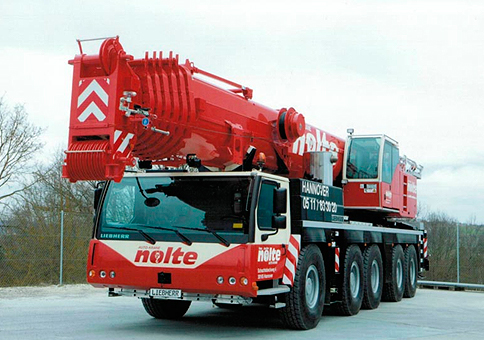
Yeah, for those it makes sense to have the driver's cabin so low to the ground. Also for heavy-duty auto cranes (https://www.gelbe-seiten-svd.de/Anzeigen/bga_grafiken/80i353...). But for trailer trucks, the downsides (mostly the severely limited visibility for the driver) far outweigh the advantages.
A few weeks ago, I saw a documentary about how inefficient and unstable these types of trucks were. It was necessary to redesign the cab's aerodynamics to achieve substantial fuel savings in these vehicles, which are inherently fuel-intensive.
Interesting design to revisit in the context of electric self-driving trucks. The cameras/radars/lidars can be attached high around the trailer, no need for the driver cabin. And the batteries are naturally placed low.
You might be surprised how low the clearance is on some over-the-road trailers. Especially the long ones for hauling heavy equipment, their breakover angles are atrocious. Most roads are navigable regardless, and they know how to pick routes that avoid impassible ones. Low as it is, this truck's clearance probably isn't as limiting as you might think.
Not the OP but I know the feelings about the Citroen BX - it was just such a drab design, looked like a shipping box, and was just generally a dull car to be around. Best feature was its suspension, which would lift the front end up during acceleration until it got to a 'settled', floating position .. that always kind of felt like doing light speed in the millenium falcon or something similiarly odd in a very, very boring car.
Yeah, most Mercedes cars from that era have a steering wheel that looked just like that. But the whole paragraph is pretty senseless. Of course it looked like a car cockpit - because you couldn't fit a truck cockpit into the available height! And the Recaro seats were probably the least they could do to have acceptable ergonomics for truck drivers who spend far longer in that seat than the average car driver.
I can't believe something like this would get any further than artist's renderings. The visibility would be shite. Even for limited purpose use like in a large warehouse lot where they need something just to move trailers around the lot. I'd have thought any dolt could see this being a problem, but I guess not
The design was driven by regulations that limited to total length of the truck but not specifically the trailer. Smaller tractor, bigger trailer, more carrying capacity, more profit. Sure, visibility is shite, but if it is legal, they will get it, because carriers are here to make money.
But it turned out not to be legal, and regulations changed, now specifying different limits for the trailer and the total length, meaning it lost its main reason for existing.
Sure, visibility would be worse than on a normal truck, but no worse than a low sportscar (which is also road legal and no problem to drive). I don't think it would have been much of an issue.
It's a bigger issue than one of legality. The high seat in a standard truck cab offsets two of the biggest challenges with driving a truck: it takes ages to get up to speed, and a very long distance to stop. High visibility gives better sight lines for further so the driver can plan. That helps to improve fuel efficiency by better anticipating traffic and planning acceleration accordingly. It's absolutely vital for safety because the driver needs to brake for what's happening a huge distance up the road. If you don't have that line of sight, they'd have to drive so defensively ("stop in the distance you can see to be clear") that any efficiency gains from the aero would be completely swallowed by all the accelerating and braking.
A sports car of course can stop in a heartbeat and the excess power means it can easily manage its flow in traffic. They'd perhaps not even be legal if they took as much road to stop as a loaded truck. It's four times the distance - 150ft for a decent sports car at 70mph; 600+ for a semi.



reply