Loosely that just means that if you work somewhere with a lot of employees, you'll hear that the same job in a neighboring state pays 1.5-2 times as much. And that they have a harder time firing you. And that you'll be more likely to get compensated if you get hurt or whatever. Etc etc etc because unions.
It was pitched as a way to avoid paying union dues and possibly make it easier to move around the job market. And especially avoid working with "those" people.
If you sensed the ick factor there, that's why I think it's hard to have a rational debate around unions. It's become a divisive word like liberal due to deep-rooted disagreements going back to the founding of the (cough) union.
I prefer to use a term like representation. Do we want an advocate between us and the bosses when the next round of layoffs comes? Of course. Do we want our own form of human resources (HR) that has real teeth when something violent or inappropriate happens to a coworker? Of course. Do we want to have our voices heard when it comes to the quality of our work environment? Of course.
When people agree on principles but not on the umbrella term that covers them, it makes them vulnerable to political manipulation so that they can be divided and convinced to vote against their own interests.
I understand that a free market where people can switch jobs easily might be seen as more ideal than unions. But do we live in that market really? How many cities in America have a handful of large companies propping up the local economy? How many of those companies would take us in if we got fired from the other companies? How often do we hear about people moving to another city because they can't find a job?
There seems to be quite a discrepancy between the ideal and the actual. Another way to make people vulnerable to political manipulation.
I think maybe it comes down to how we see ourselves as blue collar or white collar. I understand how unions might be against the interests of white collar workers who tell blue collar workers what to do. What I can't understand is why blue collar workers would be against unions. What is the rationale there, really?
Without logic, we're left with bad faith arguments. Unions don't exist much these days for the same reasons that people on food stamps vote for billionaires. There's an irony there that their hope for opportunity gets used against them in a negative reinforcement loop. It's plain to see, and yet no help is coming.
If companies decide who gets hired instead of the people doing the work, that would seem to open the door to corruption and prejudice. So it's interesting that we might associate unions with mob activity, but not the existing corporate status quo. Why is that?
If anyone wants breadcrumbs, I just did a deep dive and there are a couple of promising technologies that could terraform Venus on roughly a human timescale of 100 years:
* Sun shade/sail near L1 tipped up to 35 degrees to remain still: 5 micron polymer film (1.5-3.5 billion tons or 10-25 million SpaceX Starship launches at 150 tons each) or 50 layer graphene (15 thousand tons or 100 launches). Liquid CO2 ocean forms at 31 C or 88 F, or dry ice glaciers at -78 C or -108 F result in nitrogen atmosphere dropped from 92 times pressure to close to Earth's pressure. Shade rotation can simulate a 24 hour day.
* Comets to increase water and spin rate: 50-100 100 km diameter comets from Kuiper Belt at 30 AU, nuclear rocket using 1% of water to gravitationally slingshot comets by planets over 20-100 years to impact at equator, resulting in 50 day retrograde or 64 day prograde rotation (down from 243 days). Decreases temperature and sulphuric acid enough for microbes to start fixing CO2 and acid.
The "hard" parts are getting bots into orbit to blow graphene bubbles to form a honeycomb, and inventing open-ended fusion rockets to avoid containment issues.
I think the sun shade is probably how we'll slow global climate change until we can plant the 1-10 trillion trees it will take to reverse it (mechanical carbon capture can't be scaled enough practically), but I digress.
Note that the blocker is actually getting to low Earth orbit (LEO) since delta V is straightforward with ion engines. That will arguably be a solved problem once big "dumb" rockets like Starship scale. I'm a big fan of JP Aerospace's airship to orbit concept and other magnetohydrodynamic (MHD) craft, but it's unclear if they will be able to achieve heavy lift. Aerospike engines and exotic rockets are being evolved by AI currently.
Spitballing here, you might be able to use some sort of floating wind turbine, and trail it out on a long enough cable to catch a different windstream. There's all sorts of reasons why it's a pretty terrible idea.
Forgotten: genetically modified algae-like organisms that would float at the habitable-ish altitude due to having a gas bubble. These organisms should consume sunlight and transform gaseous substances into something more solid/liquid to rain it down onto the surface, thus making the atmosphere less thick and more transparent. Bonus points for binding and removing chlorine and leaving oxygen intact.
Has anyone made a sandbox site running every type of container and presenting a shell where users can try to break out of any uncompromised ones remaining?
It's self-evident that we should only run containers that haven't been pwned yet.
I suspect that with all of the CVE-20XX exploits, Heartbleed, Meltdown, Rowhammer, Spectre, etc, that we're all living in a fantasy and there simply are no secure containers.
Seems a good place to repeat a quote from Theo de Raadt:
You are absolutely deluded, if not stupid, if you think that a worldwide collection of software engineers who can't write operating systems or applications without security holes, can then turn around and suddenly write virtualization layers without security holes.
He'd probably say the same about container architectures.
I've been looking for 200+ hp engine swaps for my 100 hp, 125 lb-ft of torque lifted 1986 Toyota pickup with 31" tires (like the one on Back to the Future but 1 year newer and not extended cab).
For comparison, my 2013 Nissan Leaf has 107 hp, about 200 lb-ft of torque, weighs the same 3300 lbs, and does 0-60 mph in about 7-10 seconds depending on the weather.
So even accounting for the 300-500 lb weight of the 22r engine and accessories vs 1000+ lbs of electric motor and batteries, doubling the hp would be ludicrous speed (0-60 mph under 6 seconds), by all but 2010s era EV times.
I just looked up the price of Nissan Leaf battery swaps:
  24 kWh (refurbished): 84 miles of range, $3,500-$5,000
  40 kWh (upgrade): 125 miles of range, $6,500-$8,000
  62 kWh (advanced upgrade, requires reshaping): 195 miles of range, $12,000-$14,500

  Labor: Approximately 5-7 hours of labor at $100-$150/hour, adding $500-$1,500 to the total.
I'm part of the "radical center" politically (the opposite of centrist/moderate, popularized by Thom Hartmann and others), so this disappoints both sides of my sensibilities.
An electric motor is far easier to build than a gas engine, so should cost less than a crate engine (which are typically $2,000-7,000). Of course that's limited by copper and aluminum prices (not to mention lithium for batteries). Edit: wouldn't want to forget rare earths like neodymium either!
I believe that the decades-long delay in EV manufacturing (see Who Killed the Electric Car) was a supply chain problem, not a tech problem, since we've known how to do this since the 1980s and arguably for more like a century since the first cars were EV/biofuel powered and we've had nickel-iron and sodium-sulfur batteries forever that could have done the job, but I digress.
If/when the economy crashes in 2027/2028, and after voters demand better, I'd expect a cottage industry to open up again that builds EV parts for 1/2 price or less.
It remains to be seen what they actually end up selling for, but it seems like Slate intend to offer a 200 hp motor, 52 kWh battery ... and the rest of a whole vehicle for $28k. That makes $27k for this "eCrate" package (which, granted, comes with 14 kWh more battery) seem like an absolutely terrible price.
Oh man. I used PostScript a ton when I worked at hp 20 years ago. It's actually a pretty great language, like lisp/scheme but I found it to be more approachable somehow. Maybe because it's postfix instead of prefix?
Anyway, it had several fatal flaws. I don't think it could handle images natively, so instead it encoded them as vectors and those files took up MB. It probably just needed a metaphor like iframe.
I remember when Apple switched to the PDF engine in Quartz in preparation for OS X in the late 90s, I thought it was a mistake then. The QuickDraw it was replacing was actually quite good, in some ways the epitome of C-style rendering. And Cocoa was refreshing at first (it handled stuff like palettes and gamma in a data-driven way instead of through leaky abstractions) but without a way to transition off QuickDraw, it felt like more busywork that had to be done just to keep up.
Apple seems to have lost its academic roots, and suffers for it now. Or I should say, its customers suffer while it grosses almost half a trillion dollars per year. At least with vibe coding we can just whip up a Preview app in an afternoon, so maybe none of this matters anymore.
> Apple seems to have lost its academic roots, and suffers for it now. Or I should say, its customers suffer while it grosses almost half a trillion dollars per year. At least with vibe coding we can just whip up a Preview app in an afternoon, so maybe none of this matters anymore.
Eh, I'm with Apple on this one: we can just use Ghostscript. Apple's move effectively forces the few applications that need to use PostScript on macOS to migrate from a proprietary PostScript implementation to an OSS one, which strikes me as ultimately a good thing.
> .. with vibe coding we can just whip up a Preview app
why deflate your own position with this (worthless-untrue-spineless) statement? Which library is doing the work? who writes that library and maintains it?
that was a real product with ordinary thousands of hours of skilled coding in there.. That is certainly the part that is doing work. Secondly someone really knows what they are doing to slip in those architectural layers / shims / pipes .. Very impressive IMHO
Yes, PostScript is a great general purpose high level programming language, kind of like a cross between Forth and Lisp, but a lot more like Lisp, with its polymorphic homoiconic data structures that were essentially JSON.
>PostScript is kind of like a cross between Forth and Lisp, but a lot more like Lisp actually. And its data structures, which also represent its code, are essentially s-expressions or JSON (polymorphic dicts, arrays, numbers, booleans, nulls, strings, names (interned strings), operators (internal primitives), etc.)
>Kragen is right that PostScript is a lot more like Lisp or Smalltalk than Forth, especially when you use Owen Densmore's object oriented PostScript programming system (which NeWS was based on). PostScript is semantically very different and much higher level that Forth, and syntactically similar to Forth but uses totally different names (exch instead of swap, pop instead of drop, etc).
>You're welcome! OOPS (Object Oriented PostScript ;), I meant to say that PostScript and Lisp are homoiconic, but Forth is not. The PSIBER paper on medium goes into that (but doesn't mention the word homoiconic, just describes how PS data structures are PS code, so a data editor is a code editor too).
The Shape of PSIBER Space: PostScript Interactive Bug Eradication Routines — October 1989:
>PostScript is often compared to Forth, but what it lacks in relation
to Forth is a user-extensible compiler. You can write your own
PostScript control structures and whatnot, like case and cond, to
which you pass procedures as arguments on the stack, but the
PostScript scanner is not smart -- but there is no preprocessing done
to the PostScript text being read in, like the way immediate words in
Forth can take control and manipulate the contents of the dictionary
and stack while the text source is being read in and compiled, or like
the way Lisp macros work. This is one of the things I would like to
be able to do with something like LispScript.
>"Lisp is the language for people who want everything, and are willing to pay for it." -Russell Brand (the old school Lisp hacker "wuthel" from MIT, not the crazy MAGA rapist)
If you want to efficiently implement a PostScript interpreter with rendering in the web browser (or node), you just have to reach for the canvas 2d rendering context, which is essentially the full PostScript stencil/paint imaging model upgraded to the Porter/Duff compositing model with alpha channels, but without the user defined font rendering and halftoning machinery (which you could implement on top of it).
PostScript has always had the black and white "image" and "imagemask" operators, but they are clumsy, don't support any kind of image processing, and you have to use "readhexstring" to read hex images, but later versions support color images.
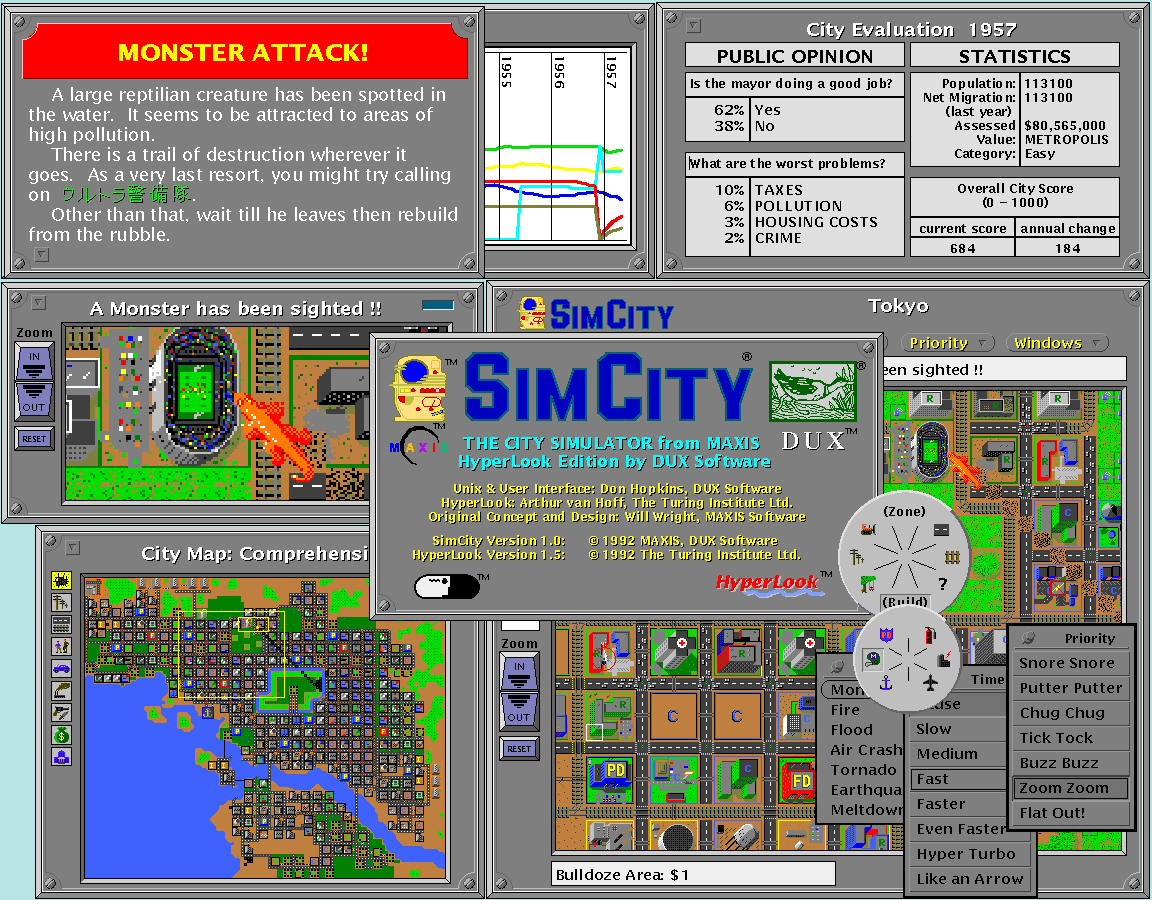
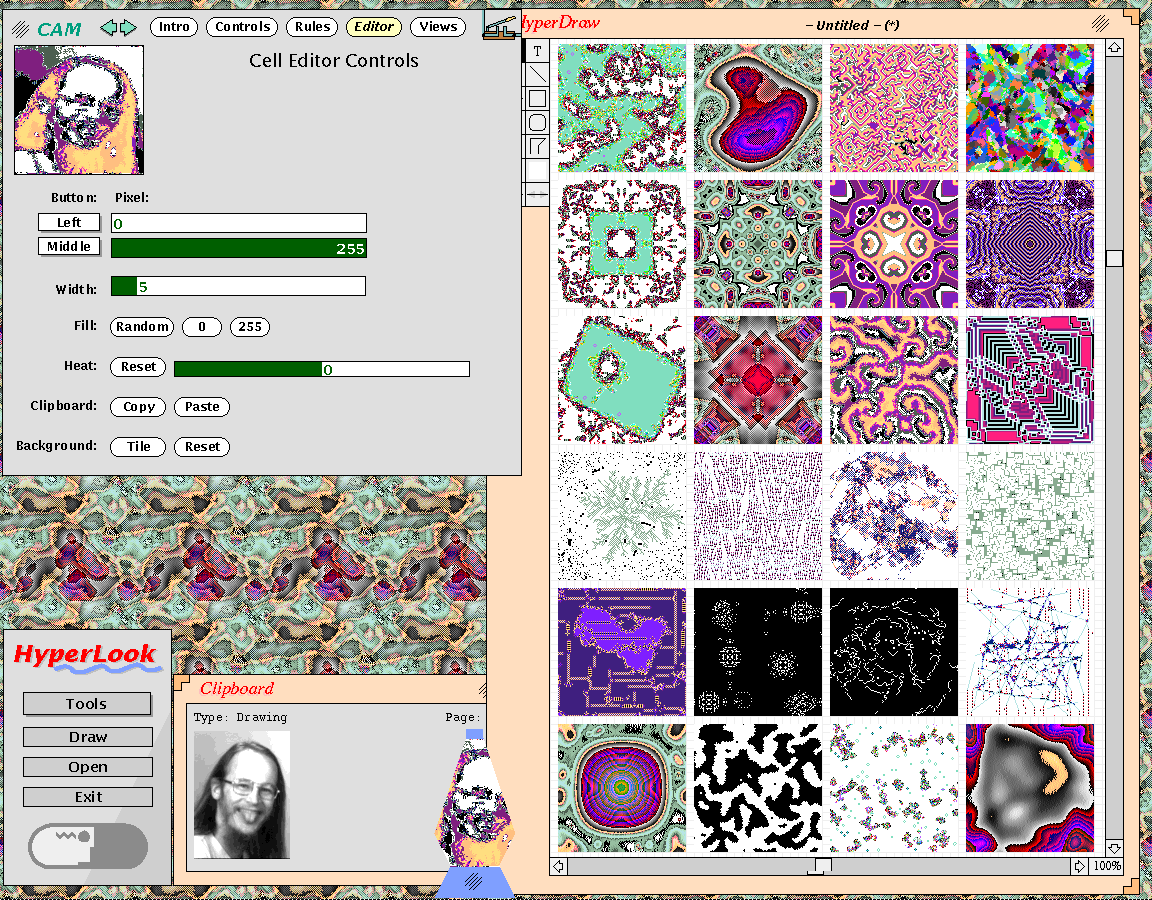
NeWS has "readcanvas" to directly read binary Sun raster files (including color) from files and over the network. It also had memory mapped canvases, which I used for the HyperLook version of SimCity so the C simulator engine could efficiently render the tiles and map views with overlays into memory, and NeWS could scale and render them quickly. I also used memory mapped canvases for my NeWS/HyperLook cellular automata machine, which was implemented in C and scaled and rendered and had a real time painting UI implemented in NeWS PostScript (the client and server took turns "owning" the pixels by ping-ponging messages over the localhost network, so each could draw into the cells in turn, and you could render PostScript directly into the 8-bit color cells for interesting effects, melt people's faces, and clip them on the screen to a window in the shape of a lava lamp).
The Apple PostScript printer drivers used (and Adobe's Blue Book documented) an indirect but efficient hack that tricked the custom halftone rendering machinery into performing a perfect pattern fill (so you could print MacDraw files, etc).
DonHopkins on March 13, 2020 | parent | context | favorite | on: Finding Mona Lisa in the Game of Life
Error diffusion dithering would work very well as initial conditions for many cellular automata rules like Life, especially counting rules (which life is) that stay alive with intermediate numbers of neighbors.
Conway's Life stays alive with 2 or 3 neighbors out of 9, or 2/9 .. 3/9, so gray scales between 22% .. 33% would be the most active.
Halftone screens would have different results, but their regularity might work well with certain CA rules and screens.
PostScript gives you a lot of control over the halftone screen definition.
Halftone screens can use any kind of repeating pattern, there just has to be the proper ratio of white to black pixels to make it look the right brightness. You could even design a set of halftone screen patterns that were precisely matched with a particular cellular automata rule to produce interesting fertile or static patterns. And you can even use any arbitrary pattern for each level, even if they aren't the right brightness, for aesthetic reasons.
The original PostScript LaserWriter was able to efficiently perform pattern fills to print tiled MacDraw images, by defining a custom halftone screen for each tile pixel pattern, that printed precisely the right pixels when you set just the right gray level: the ratio of on pixels to the total number of pixels in the tile. The spot function basically tells the halftone screen machinery what order to turn the dots on as the gray level goes from 1 to 0 (which results is seamless tiling with nearby gray tiles). Take a look at the PostScript header of an old MacDraw file some time to see the really bizarre code that does that by abusing the "setscreen" operator with a contrived spot function. (That was extremely tricky and gave GhostScript problems for years. The trick is documented in Program 15 page 193 of the awesome PostScript "Blue Book", and it uses a lot of memory! It's one of the coolest tricky PostScript hacks I've ever seen!)
>This program demonstrates how to fill an area with a bitmap pattern using the POSTSCRIPT halftone screen machinery. The setscreen operator is intended for halftones and a reasonable default screen is provided by each POSTSCRIPT implementation. It can also be used for repeating patterns but the device dependent nature of the setscreen operator can produce different results on different printers. As a solution to this problem the procedure, ‘‘setuserscreen,’’ is defined to provide a device independent interface to the device dependent setscreen operator.
>IMPLEMENTATION NOTE: Creating low frequency screens (below 60 lines per inch in device space) may require a great deal of memory. On printing devices with limited memory, a limitcheck error occurs when storage is exceeded. To avoid this error, it is best to minimize memory use by specifying a repeating pattern that is a multiple of 16 bits wide (in the device x-direction) and a screen angle of zero
It's partially because the internet only grants us free storage (noun), not free compute (verb).
Which is fundamental to so many XY problems, including why cloud services are so byzantine instead of just providing isolated secure shells with full root access within them. And why distrust is a growing force in the world instead of, say, unconditional love.
I always dreamed of winning the internet lottery so that I could help dismantle the systems of control which currently dominate our lives. Which starts with challenging paradigms from first principles. That looks like asking why we only have multicore computing in the cloud and not on our desktops (which could be used to build our own cloud servers).
When we're missing an abstraction layer, that creates injustice and a power drain from the many to the few. Some examples:
- CPU -> multicore MIMD (missing) -> GPU (based on the subset SIMD instead of MIMD upon which graphics libraries could be built)
- UDP -> connectionless reliable stream (missing) -> TCP (should have been a layer above UDB not beside it)
- UDP/TCP -> P2P (NAT and other limitations block this and were inherited by IPv6 as generational trauma) -> WebRTC (redundant if we had P2P that "just works")
- internet connection -> symmetric upload/download speed (blocked for legal reasons under the guise of overselling to reduce cost) -> self-hosted web servers (rare due to antitrust issues stemming from said legal reasons)
- internet connection -> multicast (missing due to suppression of content-addressable-memory/hash-tree/DHT/) -> self-hosted streaming (negates the need for regions and edge caching)
I had high hopes for Google and even Tesla (for disrupting the physical world). But instead of open standards, they gave us proprietary vendor lock-in: Google Workspace (formerly G Suite) and NACS instead of J1772 (better yet both). Because of their refusal to interoperate at the lowest levels, there is little hope that they will do the real work of solving the hard problems at the highest levels.
For example, I just heard that China has built thousands of battery swap stations to provide effectively instant charging for electric vehicles, whereas that's something that Tesla can't accomplish because they chose to build Supercharger stations instead.
Once we begin to see the world this way, it's impossible to unsee it. It calls into question the fundamentals (like scarcity) which capitalism is based upon, and even the concept of profit itself.
From a spiritual perspective, I believe that this understanding is what blocks me from using my talents to use the system for personal gain to win the internet lottery. The people who own the systems of control don't have this understanding, and even view its basis in empathy as a liability. So we sacrifice the good of the many for the good of the few and call that progress.
In his 1999 book "Entering Space: Creating a Spacefaring Civilization", Robert Zubrin mentioned checking the math for Bussard ramjets with Dana Andrews in their 1988 join paper "Magnetic Sails and Interstellar Travel" and found that they aren't capable of reaching more than a few percent of the speed of light before drag overcomes propulsion:
That's not to say that they don't work. But they'll probably be used primarily for braking to enter orbit around destination stars.
Probably the only way to reach a high fraction of the speed of light is to construct a giant laser to beam energy to a spaceship (which uses a reflector to receive light pressure momentum) and leave it behind orbiting the origin star. That's the premise of the Breakthrough Starshot project, which is ambitious with today's technology. But with self-replicating makerbots, building one may not be a big deal.
Unfortunately the force of light pressure (by F=2P/c for full reflection) is only about 2/3 of a kg or 1.5 lbs per GW, so a TW or greater would be needed for practical thrust. However, light pressure becomes the most efficient form of propulsion above about 25% to 50% c, if fusion or antimatter is used to create a gamma ray rocket.
Personally, I find it unlikely that aliens use these methods. I think that they probably worked out how to build neutrino lasers, since they don't burn up objects in their wake, perhaps by scaling superradiant Bose Einstein condensates:
In embarrassingly oversimplified layman's terms, I think that works by recruiting the macro-scale quantum state of the condensate (increased cross-section or barn) to overcome the short interaction distance of the weak force. Or by cooling the atoms to such an extent that they don't have the energy to hold themselves apart anymore, which accelerates their decay. I'm sure my explanations are wrong somehow.
Soon we may be able to investigate stuff like gravity waves and how the fabric of spacetime may be able to rebound above flat to create tiny ripples that allow mass energy to escape black holes, for example. I know that current theories don't state it quite that way, but if we consider stuff like the no-hair theorem and black box thought experiments, it's hard to see how Hawking radiation could exist without the wavelike nature of spacetime. We can even experiment with it on a relatively large scale by measuring the Casimir force. If we can rebound space, then we can play with stuff like negative energy and Alcubierre drives.
I looked up a Dyson sphere made from Mercury and it would be 1.5 mm thick, so aliens almost certainly aren't building them. But Dyson rings and swarms are probably a thing.
Some people in the tinfoil hat crowd think that UFOs can move 4th dimensionally and just travel orthogonally to our space and appear somewhere else. Theoretically, that might only require the energy difference (delta v) between planets. That hinges on if gravity spans higher dimensions and also touches on the multiverse. I'm way outside my wheelhouse so I'll stop blabbering about that.
In all honesty though, I question whether aliens travel. I think civilizations ascend about 10 years after they implement AI, or annihilate themselves in a Great Filter, their equivalent of WWIII. We're already staring the secrets of the universe in the face with automated theorem provers. And FUD around that and other accelerating tech drives people to become Luddites and elect amoral people who would gladly see the world burn for profit. So things could go either way really.
In my heart, I feel like we have a childlike understanding of consciousness. It probably transcends 4D spacetime. It's not hard to imagine aliens scaling what was learned from the CIA Gateway Program and doing stuff like FTL message passing via remote viewing. At that point FTL teleportation comes into the realm of possibility, sort of like in Dune.
If so, then aliens are probably everywhere, know about us, and maybe had a hand in our evolution. The probably live in what we think of as a Matrix, where years could go by for every second of our time. Another interpretation might be that they're able to return to source consciousness and exist as one, rather than in separation like we do. Maybe they periodically choose to reincarnate in us to study what transitioning to a spacefaring civilization looks like.
I probably shouldn't have bothered writing all of this, but it's Sunday, and I also really don't want to do my taxes.


https://en.wikipedia.org/wiki/Right-to-work_law
Loosely that just means that if you work somewhere with a lot of employees, you'll hear that the same job in a neighboring state pays 1.5-2 times as much. And that they have a harder time firing you. And that you'll be more likely to get compensated if you get hurt or whatever. Etc etc etc because unions.
It was pitched as a way to avoid paying union dues and possibly make it easier to move around the job market. And especially avoid working with "those" people.
If you sensed the ick factor there, that's why I think it's hard to have a rational debate around unions. It's become a divisive word like liberal due to deep-rooted disagreements going back to the founding of the (cough) union.
I prefer to use a term like representation. Do we want an advocate between us and the bosses when the next round of layoffs comes? Of course. Do we want our own form of human resources (HR) that has real teeth when something violent or inappropriate happens to a coworker? Of course. Do we want to have our voices heard when it comes to the quality of our work environment? Of course.
When people agree on principles but not on the umbrella term that covers them, it makes them vulnerable to political manipulation so that they can be divided and convinced to vote against their own interests.
I understand that a free market where people can switch jobs easily might be seen as more ideal than unions. But do we live in that market really? How many cities in America have a handful of large companies propping up the local economy? How many of those companies would take us in if we got fired from the other companies? How often do we hear about people moving to another city because they can't find a job?
There seems to be quite a discrepancy between the ideal and the actual. Another way to make people vulnerable to political manipulation.
I think maybe it comes down to how we see ourselves as blue collar or white collar. I understand how unions might be against the interests of white collar workers who tell blue collar workers what to do. What I can't understand is why blue collar workers would be against unions. What is the rationale there, really?
Without logic, we're left with bad faith arguments. Unions don't exist much these days for the same reasons that people on food stamps vote for billionaires. There's an irony there that their hope for opportunity gets used against them in a negative reinforcement loop. It's plain to see, and yet no help is coming.
If companies decide who gets hired instead of the people doing the work, that would seem to open the door to corruption and prejudice. So it's interesting that we might associate unions with mob activity, but not the existing corporate status quo. Why is that?
reply