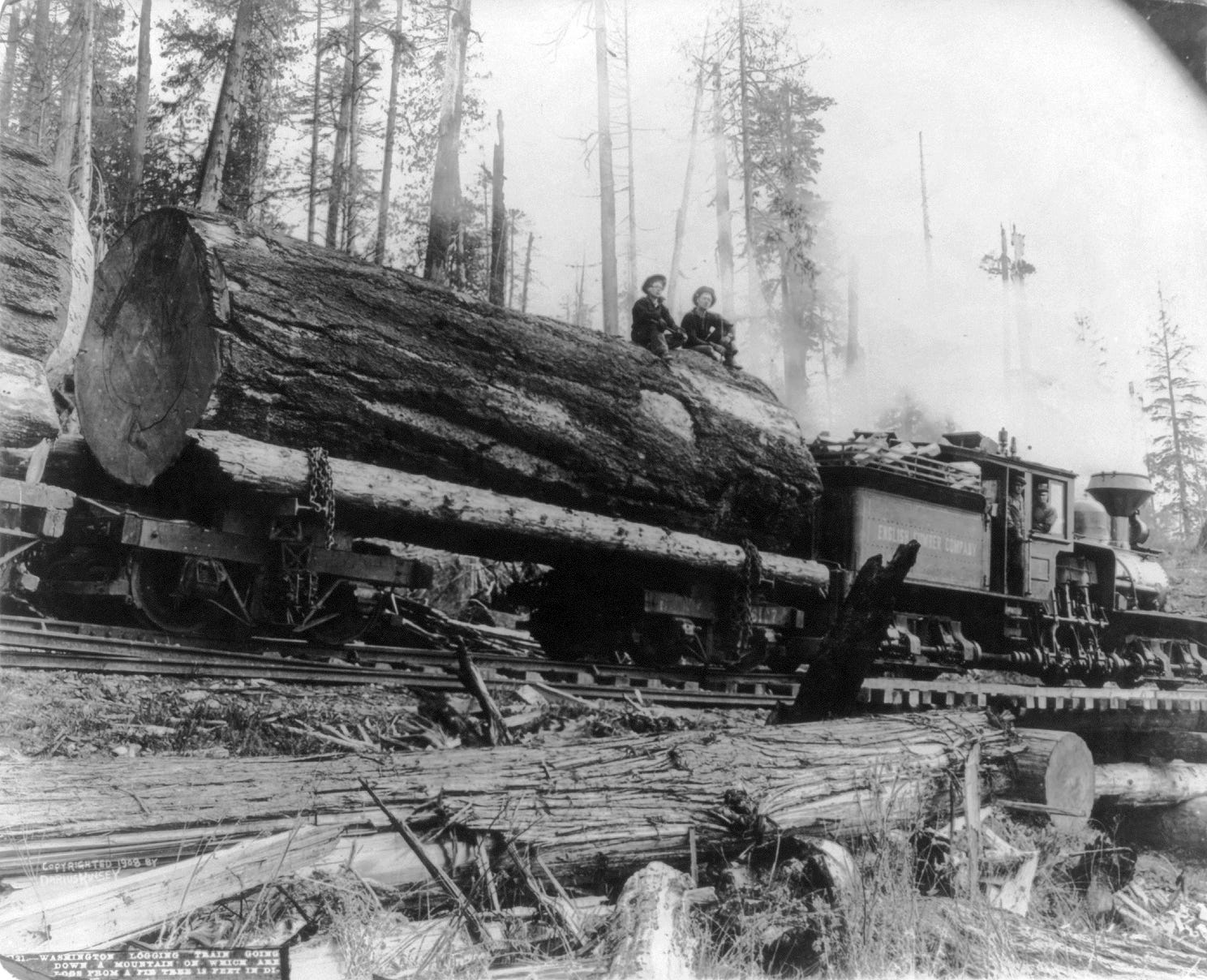
Quality lumber is incredibly expensive now compared with 1914. I owned a 1910s-construction house for a while, and they used huge, thick wooden boards around the foundation where the structure met the stone-and-mortar basement walls, and in the floor joists (visible in the basement), and in the diagonally-run underfloor boards (used where we'd use plywood, today). Nearly knot-free, perfectly straight, that stuff would probably be put aside for high-end fine woodworking or even veneer-making, now. It was beautiful stuff and they stuck it under the floors. The ones around the walls must have been something like 8"x14" or bigger, and tens of feet long. Nearly-flawless pieces of lumber. I assume the wood used in the wall framing (some pieces likely three stories long—it was a balloon-construction house) was similarly astoundingly-good by modern standards.
That stuff was, evidently, so cheap from the perspective of people in the 1910s, that they didn't think it worth any amount of effort to sub in worse wood for places where looks didn't matter. These days, some of that would be hard to find at any price, short of salvaging it from old buildings like that. And that's the "crap" they put under the nice wood they used for finishing!
OTOH we do have drywall, which has got to be cheaper in pretty much every way than lathe-and-plaster.
I live in Canada, where we are swimming in lumber (in theory). I just don't understand why it is so expensive. I know the processing and treatment is very sophisticated but there is so much automation throughout the whole chain. My only explanation is that lumber is a globally traded commodity .. price isn't determined by just Canadian demand for lumber but the global demand.
It makes me wonder .. if the US shutdown Canadian wood imports, would that significantly lower prices for Canadian consumers? How low would it go?
my un-schooled guess is simple - the rest of the industrialized world has benefited from profit markups in real dollars of today - that fun book or skateboard was priced in modern terms.. while lumber is a commodity from the previous century or three.. their dollars and costs were low to start with, and were pressed down by commodity markets.
I once asked a recent undergrad in Economics graduate, at a party, why one pound of bread costs more than one pound of meat (the inputs and processing costs are vastly different, through the life of the animal, the meat should be way, way more) but, blank stare, more beer.
I for one believe that most of the markets, most of the time, make no sense at all from the perspective of the real natural inputs, and all the sense in the world from the point of view of one human group selling things to another human group, any way they can; old timber included.
Bread doesn't seem like the best example here, because the finished product is not dense, can't be smushed, and has to get shipped to the store. Transport plus the shelf space (and rotation) can explain most of the price.
If you look at pure flour, rice, beans, pasta, and stuff like that, there are lots of cases where it drops from prepared-foods price down to something closer to its commodity value. Looking up rice, it goes for $14/c.w.t., which I think translates to a little over $0.10 per pound. You can't buy it at that price, but you can buy a literal 1 lb bag of the bad rice for $1.00. Consider larger quantities and you'll probably see an asymptote to a reasonable multiple times the commodity value.
Meat will not follow those rules. The floor for meat is much higher due to the physical inefficiency of production. Even at that higher price floor, there are huge untaxed externalities. A lot of people know the reality that we have to eat a lot less meat due to halt climate change. I think there is a strong business and social culture for businesses to move meat at close to its price floor, with business models like fast food.
as a consumer, I will walk to the corner store here in the California city, and I will check the price of a loaf of ordinary bread, and the price of a pound of ordinary meat, again today or tomorrow. Not "the cheapest rice by the ten pound bag" .. or "chicken parts whole in a ten pound bag" I believe my point stands.. yes, there are layers in the consumer markets.. times one hundred for a fast food meal, too.
Where is a pound of meat cheaper than a pound of bread?
Either way, no offense, but your economics grad needs to re-take some basic classes. To simplify, input costs only establish a floor on prices. Otherwise, prices are set by dynamic market supply/demand curves.
>It makes me wonder .. if the US shutdown Canadian wood imports, would that significantly lower prices for Canadian consumers? How low would it go?
It probably wouldnt go low because you are not recognising global demand and a growing global population, cost of automation for factory (automated built) furniture, bespoke furniture by individual or small teams of carpenters, cost of transporting wood to other countries where costs are different.
Here in the UK we have this place https://www.oakfurnitureland.co.uk/ it does real solid (oak) wood furniture, not some furniture made of chipboard.
It seems quite cheap but there are visible cost savings, like the furniture isnt that big, its suited to smaller homes than some grand mansion or luxury home, and with a lot of businesses, where finance/credit is available, sometimes the company main business is actually a credit broker/finance specialising in a niche market product.
Some people have said GE (General Electric) is now more a financial entity than a manufacturer, this is business diversification over the decades.
> the furniture isnt that big, its suited to smaller homes
To be fair, pretty much anything built after 1960 is small, and all UK housing is small by American standards.
I also don't think most people in the UK consider OakFurnitureLand a cheap, or even an affordable place to buy furniture. Despite being made of cheap internationally sourced oak, and somewhat mediocre, it's definitely a premium brand. If you were to buy all your furniture there many people would consider you well off.
Spot on with the reality of their finance business though
I spent quite a lot of time in https://www.oakfurnitureland.co.uk/ returns outlet picking through stuff. I furnished most of a house from there. The furniture is made in places like Thailand, and woods like mango are used as well as 'oak'. They must make reasonable margins even with the normal prices they charge. I'm sure they also benefit at least on their lower tier of credit plus upsells on insurance etc. I didn't encounter any of that as the outlet was strictly cash.
Even the carcasses use solid wood. Some of the returned furniture had cracks in interior wooden boards where a composite like ply/chip/MDF would not have cracked. I guess solid wood is lighter, part of their brand and they have less diversity of material sourcing. It must pay off, even with slightly higher returns.
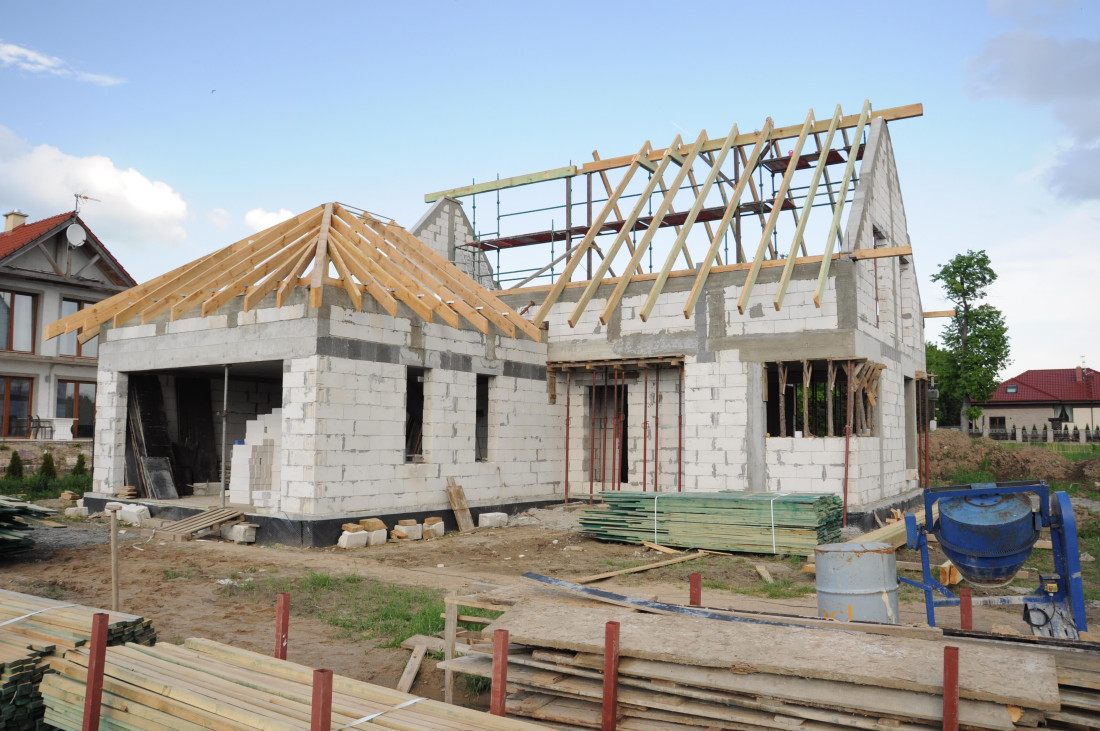
I don't think most countries build houses of wood like North America does. In Europe houses are mostly built of various kinds of bricks and concrete. Only the roofs in detached houses are usually made of wood (and not all of them).
In the American south, there are a lot of masonry, or concrete homes or even AAC. See florida.
In the north masonry homes have a lot of problems with freeze thaw cycles. As far as upgrades
, remodeling, overall costs goes stick built homes are superior.
> In the north masonry homes have a lot of problems with freeze thaw cycles
That's weird, central Europe has pretty northern climate with cold snowy winters and hot summers and I've never heard about any such problems. I've lived my whole life in such houses. You just need proper insulation (but you need it anyway cause heating is expansive). I think Americans don't much care for good windows for example, at least in the movies they have these weird 1-layer sliding windows that nobody would use here :).
> As far as upgrades , remodeling, overall costs goes stick built homes are superior.
There's a bit of stigma against wooden houses here and they are considered worse investment because they degrade and lose value much faster.
Single pane windows are not common in the US in anything built in the last 30 years or so (give or take a few decades). Sliding windows are usually 2 or even 3 pane. Movies use single pane candy "glass" windows so characters can be thrown through them.
I would not be surprised if Canadian lumber was going to China. I believe a lot of Alaskan lumber, if not the majority of it, was China bound (this may have been close to two decades ago though when I had heard that).
Canadians are so stupid that we have allowed raw logs to be sold to Chinese offshore lumber mill ships, to be sold back to us, instead of insisting that the value-added processes be kept on-shore so that we have good-paying jobs for our own citizens.
> so that we have good-paying jobs for our own citizens.
Protectionism isn't always a good idea. Doing so would've made the final lumber output more expensive for Canadian consumers.
Automation is coming for the good-paying jobs sooner or later, anyways. The solution wasn't/isn't to ban outsourcing/automation, it's to better distribute the gains from outsourcing/automation across society.
The better mills have amazing automation. Penetrating scan of the log and then laser-guided slicing and dicing to maximize wood usage and profitability.
Now if only the lumber were properly dried instead of shipped slopping wet. (Actually, I suspect the kiln-dried lumber is destined for wealthy foreign markets; we locals get the c-grade crap. I have spent literally more than an hour picking through stacks to find enough good lumber to build a shed.)
The kiln drying process is exactly why you get what you get. When you crank the kiln to 11 in order to get the most throughput out of it you get residual stress and bent boards.
A covered pile outdoors or in a warehouse will yield straighter lumber (or just don't crank the kiln to 11) but that is not economically viable for random pine that people frame things with.
Canadians know that - they have only to look at dairy. Milk is probably fine from a consumer perspective (just not if you want to get into farming it), but whether deliberately or as a side-effect it cripples cheese.
Imagine my great-grandfather planted a seed 150 years ago for $0, then we did nothing but wait for 150 years, then I chop it down and get $100 of lumber.
But you can't enter the market and compete with me, because you don't have the right grandfather.
Property values in Canada are quite high. That free free squatted on non-free land for 150 years before you got to chop it down. How many dollars per year did the land cost for those 150 years?
This reminded me of the fact that the US Navy maintains a forest of trees that are of appropriate size to keep planks for the USS Constitution, the last remaining wooden US Navy vessel.
Sweden planted 300,000 oak trees on a particular island in the 1830s, after the Napoleonic wars, to provide lumber for future naval ships. It takes the trees about 150 years to reach a suitable size, so they were well obsolete for their intended purpose before they were ready.
> Quality lumber is incredibly expensive now compared with 1914.... Nearly knot-free, perfectly straight, that stuff would probably be put aside for high-end fine woodworking or even veneer-making, now. It was beautiful stuff and they stuck it under the floors.
Could that have been lumber from old growth forests that are now either extinct or protected from logging?
IIRC, lumber nowadays is basically farmed using relatively fast-growing trees.
I don't know if it is true that quality today is worse, but they used way more wood for heating back then. So maybe they picked the nice trees for wood work and lit up the rest.
Trees on plantation are straighter than wild trees.
I'm really curious to know why, in our hyper-industrialized world of today, is lumber so expensive when compared to yesteryear? Is it cost of land on which it grows? Is it increased demand because of population growth? Increased demand because of new uses? Increased demand because of global markets? Is it because lumbar prices were artificially depressed because the cost of growing new trees was not included (because people were just cutting down what was already there). Maybe it is because land/housing prices have gone up so much, people are just willing to spend more as it is a relative small percentage of the total cost of housing?
My understanding is that the trees no longer exist. We cut down ancient hardwood forests that took hundreds and thousands of years to grow. All of that is gone now except in a few places like national parks and monuments. In its place are tree farms that are harvested after growing for a few years. Instead of cutting down trees that are 4 feet across with beautiful straight grain knot free lumber, we get crap heartwood with knots that bows and warps.
To get that beautiful wood again, we would have to plant the forests, let them grow for hundreds of years, then harvest the wood. Well, that's not going to happen, so we end up in the situation we are in of having to use a very poor substitute.
This. You buy a 4"x4" post (nominal. Actually 3.5"x3.5") at your local home improvement store and it has wane on all four corners and the pith running down the middle.
Translation: it's made from the smallest possible tree you could plausibly saw a 4x4 out of. And the pith (the center of the trunk) running through the middle guarantees that the post will split along the radial plane as it dries.
If you go to a better lumber yard, you get better lumber. Except, apparently, for 2x3's. They are universally crap. Source: built a chicken coop with 2x3's and bought from a local outfit because they deliver inexpensively. Everything else was gorgeous compared to the box home improvement store. The 2x3's were pretty much the same.
Heard you should get the largest lumber you can get and rip it down. Like get 2 x 12's and rip down to 2 x 4's.
Makes sense that the larger cross-sectional lumber needs to come from a larger cross-sectional tree with few defects. The crap-wood they can turn into 2x4, 2x3....
I did the above to create a nice workbench with few knots. It helped of course that the lumber I ripped was glued up to make the butcher-block-style top, the uprights and cross braces also doubled, tripled up.
North america was heavily deforested during the pleistocene which wasn't really all that long ago. You can also find historic pictures of mass clear cutting from the start of the 1900s that are now heavily forested and will eventually produce large mature trees.
My dad, born in toward the end of WWII, has complained for at least the last three decades that it keeps getting harder every year to find usable boards at lumber yards. Tons of them warped, damaged, way too many knots or other problems, and so on, and that's when you are shopping a couple tiers up from the worst stock. I don't know why that is, but that seems to be the trend he's seen over his life. Makes sense, if he came into adulthood about halfway between the unthinkably-nice framing & foundational lumber in that 1910s house, and now, and it was a somewhat continuous process instead of some sudden change.
Interesting. This might be explained by the switch from old growth to new growth^. Older trees would be larger, and have more core to work with (I think knots are mostly from the outer layers of the tree).
It's a little more complex than that. You get branches (which manifest as knots in boards) where there's sunlight that can reach the leaves on the ends of those branches.
Trees grown among other trees have to grow up to reach sunlight. The innermost part of the lower trunk might have knots from branches when the tree was young, but once they reach harvestable size, there's a fair amount of clear lumber down low.
Trees grown in the open don't have the pressure to grow upwards, and end up with branches down low throughout their lives (from the center all the way through to the bark). As a result, there's very little clear lumber in them.
Disclaimer, I'm a furnituremaker, not a forester. The above is somewhat better than pure speculation, but likely misses some important bits.
The sapwood is an approximately constant radial dimension over the life of the tree once it gets big enough to form heartwood. Sufficiently old trees are more heartwood by percentage than sapwood.
For hardwoods, it's typically the heartwood that's more desirable. Walnut and cherry both have pretty strongly contrasting sapwood that does not match the customer's expectation for the color of those woods, for instance.
That would be my guess for at least part of the reason, too, but it'd only be a guess. I also wouldn't be surprised to find out that tree species plays a role, and that we plant species for harvest that simply produce worse lumber than what used to be widely available (as old growth).
The funny thing is that the straight grained radiata pine is sold at a premium imported from Australian and New Zealand plantations when it's an American tree that could be farmed domestically.
The wood used to built those houses was the old growth timber of the western united states. Its basically gone now. As well as the second, third and fourth growth.
Wood of sufficient quality to do the things we used to do with it simply doesn't come from industrial forests.
At least in Finland, there has been a trend of forest owners to favor faster growing species or just felling them earlier. Most of the trees won't be good enough for quality lumber so it's just sold at bulk prices to paper mills. With the method you can probably get 2 good harvests in the time of one. If you let the tree grow 100 years instead of 30, you might not still get 3x the price and you would have to wait 70 years more.
A detail I liked in the Blade Runner 2049 movie was the office of the Wallace Corporation CEO -- every surface was covered in wood.
Right after seeing that movie I visited an old house where everything is wood. Huge wood cabinets, wood floors, wood ceiling, etc...
I suddenly realised that I can't afford wood furniture any more! The IKEA stuff I buy these days is made of "manufactured" materials that are "wood-like", but have essentially cardboard honeycomb between two sheets of plywood or something.
I used to have IKEA furniture that was solid pine, but good luck finding anything like that in their store these days...
Why would anyone want solid pine? Furniture has been made of veneered wood for a very long time. It has been popular since the late 17th century, long before IKEA.
It didn't take long to find it in their catalogue.
Anyway, IKEA is not the only company selling furniture.
You are correct that most solid woods are expensive (not pine usually though) but that is at least in part simply due to high demand for such furniture and the lack of supply of the raw materials.
That’s because when this country was still being settled, standing trees were an obstacle in the course of productively developing all this land, which, at the time, meant mostly agriculture. Before big machines arrived on the scene, getting rid of all of that heavy garbage was a lot of labor, and since there was a lot of trees around, and shipping them far away was way too expensive, there were few buyers, all of which made prices low. When all local trees were cut, land had been developed into farms and towns, and lumber needed to be shipped from further away, prices started going up.
Long leaf pine of the South Eastern United States is now also used as a heating and electricity generation fuel as far away as Europe. North Carolina is on track to become the World's largest single source of wood pellets[1]. On the other hand, during the lumber shortage of 2020/1 the bottleneck was at the mill.



That stuff was, evidently, so cheap from the perspective of people in the 1910s, that they didn't think it worth any amount of effort to sub in worse wood for places where looks didn't matter. These days, some of that would be hard to find at any price, short of salvaging it from old buildings like that. And that's the "crap" they put under the nice wood they used for finishing!
OTOH we do have drywall, which has got to be cheaper in pretty much every way than lathe-and-plaster.