Not a lawyer, nor am I American. No horse in this except maybe a citizen of the world. This seems like a weak case to me. For a former president and polarizing figure, you would think the bar on prosecution would be air tight. If he goes to jail for a crime the population (or his support base) considers is trivial or if he does not get convicted, it raises Trump's stock to the stratosphere. Perhaps if he goes to jail, he can't run for office? Still .. seems very dubious based on the info in the news so far.
Here is an analogy I thought of. Say my firm's database gets ransomewared. If I pay the ransom directly, that may be a particular way of accounting. But say, I pay McCohen Computer Associates to fix the problem. Why do I not book it as a computer expense? I am not an accountant but am curious how this works.
Also, booking something in the wrong accounting category, doesn't seem like a very convincing charge. On the other hand, Tax and election violations are very serious.
The prosecutor can only look at crimes in their jurisdiction. In this case it's a NY prosecutor and only crimes in that state can be charged. In fact, we don't know what the charges are yet as they are sealed (although the leak says it's 30+ charges). There are other, stronger cases against Trump being pursued in Georgia and at the Federal level (and perhaps more than that).
In the end, this is important though as we already have convictions that his company was committing tax fraud but those don't go back to him personally because the CFO was non-cooperative (and Trump probably wasn't directly involved enough to be convicted).
The campaign finance part though is definitely personally handled by him. He allegedly used money donated by people to his campaign to pay his lawyer who then used the money to pay Stormy Daniels. That money was billed as legal expenses for the campaign. That's more than accounting fraud - it's tax fraud and it's fraud against our democracy.
The bar should be fairly air tight. Cohen has already served time for this crime. Moreover, he was charged with acting in conspiracy with “Individual 1”. While Trump will face a separate trial, with all that entails, in practice there was already a successful trial for at least some of Trump’s crime.
In your example, both payments would be legitimate business expenses.
I believe Bragg probably knows what he's doing, but the charge against Cohen isn't a good argument.
Cohen really got a raw deal from the prosecutor and basically got threatened with more charges, and his wife getting charged, unless he pleads guilty within a day or so. That's why the quality of the individual charges in that plea deal can't be taken for granted.
No, he hasn't. He pled guilty to seven unrelated financial charges and to one charge related to the payment to Stormy Daniels: making an excessive campaign contribution.
That last charge doesn't apply to Trump, who is allowed to contribute as much as he wants to his own campaign.
And Cohen's plea tells us nothing about whether recording the payment as "legal expenses" is a crime.
Assuming the charges are limited to the Daniels payment, you're correct. It's a weak case. They have to prove the misdemeanor accounting charge, then to elevate to a felony, the DA must prove that crime was used to cover-up some other more serious crime (likely campaign finance related).
The last time a similar case was brought, it was against John Edwards (who took money to pay for housing for his mistress, or something like that). He was acquitted.
But, it appears the indictment has 34(?) charges. If they're counting each check to Cohen as a charge, that's 11(?), so there's something else there. Some of that could be conspiracy charges, but we don't know.
Say my firm's database gets ransomewared. If I pay the ransom directly, that may be a particular way of accounting. But say, I pay McCohen Computer Associates to fix the problem. Why do I not book it as a computer expense? I am not an accountant but am curious how this works.
The two-step payment through Cohen is only illegal if it's done to cover up other illegal activities or it's in violation of some other law.
In this case, it's likely the hush money was funneled through Cohen to keep it off the campaign books - that's what makes it illegal.
I just want to point out that the last time a similar case was brought was against Cohen for this exact same crime. Cohen was convicted and served time in federal prison. In his trial, Cohen testified that he broke the law at the direction of somebody only referred to in the public disclosures as “Individual 1”. The only plausible person this can be is Donald Trump.
So, regardless of what you think of the case. Leaving out that somebody was already successfully convicted of this exact crime is a significant omission.
We do not know the charges yet of course. The most significant are likely to be campaign finance related with details of falsified records and hush money payments providing supporting evidence of those crimes as much as they are crimes themselves.
Just a clarification: Cohen plead guilty as part of a plea deal. So the case never went to trial with an adversarial argument of facts between Prosecution and Defense. Therefore, we don't really know how good the case was.
The fact that Cohen is a lawyer would seem to indicate that the case was solid enough that he was concerned he would lose on merit. However, a friend of mine who is managing partner in a legal firm says that "Once a trial goes to a jury, it's approximately a coin flip as to who will win, and the odds only go down from there." That's mainly because if the case is black-and-white, then there will be some settlement/plea deal prior to a trial.
However, Trump has put himself into a corner where he probably cannot accept any plea deal other than one that would drop the criminal charges but keep any misdemeanor charges. I'm not sure that the NY DA, Alvin Bragg, would be willing to do that unless the case starts falling apart. But in the case Trump will push for an aquial rather than a plea deal so that he can use it to rile up his base.
>Assuming the charges are limited to the Daniels payment, you're correct. It's a weak case.
CNN, at least, is reporting that he's facing 30 charges. If that's the case, it's probably charges related to the Trump Org's shenanigans that the corp was found guilty of. The organization's indictment had a lot of shady stuff and a lot of stuff that looked like flat out fraud. Lots of criminal looking behavior that plausibly can be directly tied to Trump himself.
> Perhaps if he goes to jail, he can't run for office?
There is no restriction on a candidate for the US presidency vis-a-vis current or former incarceration. Anyone could constitutionally run a presidential campaign or even serve while in jail. This is because the Supreme Court has held that only the Constitution can set qualification requirements. [0]
The sole, debatable exclusion seems to be the 25th Amendment, which allows the vice president and cabinet (or the president themselves) to shift presidential powers to the vice president when "the President is unable to discharge the powers and duties of his office." [1]
If he is convicted of a felony and does run for president again, then he won't be able to vote, right?
Maybe it'll be an impetus to create a clearer path for convicted felons who served their time and don't reoffend to regain their voting rights. Probably not, but it would be nice.
Convicted felons should 100% be allowed to vote though. I never quite understood the fear of letting them vote. Indeed keeping them engaged in society instead of ostracizing them feels like it helps prevent them from reoffending.
I think the idea of suspending voting rights is less about "punishment" than it is about preventing those who have demonstrated that they're willing to make choices that we've agreed are harmful to other people from voting in ways that are aligned with their poor judgment.
In practice, I think most states with laws that suspend voting rights, do so as a form of punishment. That certainly seems to be the case with states that permanently suspend voting rights even after a convicted felon has served their time.
I personally think felons currently serving time shouldn't be allowed to vote. Suspending that right temporarily seems reasonable. That's not a strong conviction I hold though. I could be convinced that voting is a right as fundamental as the other rights we still extend felons while incarcerated.
Once a felon has completed their sentence I think they should have full voting rights restored. I also think they should no longer be considered a felon, to the point where their records are sealed once they've served their sentence. The idea of "once a felon, always a felon" seems counter productive towards rehabilitation and reengaging someone in society, and simply vindictive. In most states, being convicted of a felony comes with an automatic, unspoken life sentence of always being a felon, where the ostracization continues until they die. That doesn't seem healthy for anyone, let alone the person who served their time.
* Prisoners can't vote; however, a court decided under the Human Rights Act that they should be allowed to, but so far the government has ignored this
* Once released, ex-prisoners can vote as usual
* Many convictions are "spent" after a certain amount of time [1], meaning that after that you don't need to disclose them when applying for a job etc (but nothing resulting in a prison sentence of four years or more, and there are some cases where you still have to disclose them)
As far as i know, nobody thinks any of this is a problem.
> it is about preventing those who have demonstrated that they're willing to make choices that we've agreed are harmful to other people from voting in ways that are aligned with their poor judgment.
So if you lose all your money because of poor decisions, you should also lose your ability to vote right? If you get take in by an obvious scam or cult, you should lose your right to vote too, no?
I agree with a lot of what you’ve said in the rest of the post, but this reasoning seems critically flawed because there are lots of people with fatally poor judgement and we don’t take away their voting rights. Singling out people who have ended up on the wrong side of the criminal justice system for this punitive take is flawed. They’re already being punished and removed from society. If anything, giving criminals a right to participate in government makes the government accountable to how they treat prisoners (it’s truly a dire situation here in the US) and how they choose to apply laws. Maybe we would have learned how bad the drug laws were much earlier if the government didn’t have the power to strip voting rights from citizens.
Additionally, the government makes a non trivial amount of mistakes in terms of incarcerating innocent people. So there’s a large number of people who are disenfranchised without demonstrating “bad judgement”.
Unfortunately, I may have led you astray. I should have tried to make it clear that I was making a guess as to the rationale behind suspending voting rights - one that I don't 100% agree with. I was just echoing what supporters of that particular line of thinking have said.
Having had more time to think about it, I really can't get behind any reason for suspending voting rights.
What's the actual risk of letting those serving time vote? That they'll vote for their interests? That they might use poor judgement? If that's the concern, we have a lot more people who aren't in prison who vote for their interests and demonstrate poor judgement already.
I think that those in favor of suspending voting rights have one motivation: it's just another injustice on a pile of injustices meant to separate people in the "prison system" from "normal society," causing more harm than good for actual society.
Worse it creates incentives to convict people who are likely to be political opponents to prevent them from voting. This practice also removes a voice from one of the most vulnerable groups in society, the incarcerated.
Like many things, it ties back to the failure of Reconstruction.
Many felony disenfranchisement laws were passed alongside Black Codes.
7.4 percent of African American adults are disenfranchised compared to 1.8 percent of those who are not African American.
Many but not all states put conditions on such voting. As you might expect, the severity of a state's restrictions correlates with its political leanings.
> for a former president and polarizing figure, you would think the bar on prosecution would be air tight.
This i the crux I think - It's clearly a crime, but should he be held accountable or not due to notoriety? personally, I think public figures (especially politicians) should be held to a higher standard than mere-mortals; but many seem to believe the opposite.
You don't want your <insert political candidate> arrested/prosecuted? Don't elect a morally ambiguous one then. Higher standards, not lower.
> I think public figures (especially politicians) should be held to a higher standard than mere-mortals; but many seem to believe the opposite.
I think people should be seen as equals before the law. Having one set of standards[law] for one group and a different set for another group is antithetical to rule of law which is purportedly a common American value FWIW.
Evidence? And offspring doing something on their own doesn't count.
> illegal immigrants in order to sway voter demographics
That's not how voting works.
> dossier full of lies about your opponent
Sure that one counts. Sometimes both choices are bad. But one candidate doing something bad doesn't mean you increase what the other candidate can get away with.
You'd have to be pretty naive not to acknowledge the long-term benefits to the Democratic party of increasing the Hispanic demographic. An incredible betrayal of democracy.
And as we know the Russian collusion dossier ran for years in the media. All complete lies.
And I haven't mentioned the pressure on social media companies to censor the Hunter Biden laptop story priority to an election (the facts of which were all true).
You'll note that at no point has anybody been held to account for any of the above.
But if you (alledgedly) paid some hush money to a woman 7 years ago (years past the statute of limitations) well, you're gonna be held to account then of course.
> Hunter Biden's business partner outlines Joe Biden's involvement
"The evidence sits on these three phones, I don’t want to go into anything any further. This will all be discussed with Senator Johnson and his committee and the American people can decide what’s fact"
That's pretty weak.
> You'd have to be pretty naive not to acknowledge the long-term benefits to the Democratic party of increasing the Hispanic demographic. An incredible betrayal of democracy.
Children that are born here, voting decades from now? They're not just going to blindly follow one party. That's not a betrayal of democracy.
> You'll note that at no point has anybody been held to account for any of the above.
You can't hold someone to account for making a bad dossier any more than you can hold candidates to account for saying random awful things about people. I don't know what you expect to see beyond voter dissatisfaction, which happened in droves.
And strictness of border enforcement is something the president legitimately gets to decide.
I don't know about pressure related to the laptop story and don't really want to get deeper into tangents right now.
> But if you (alledgedly) paid some hush money to a woman 7 years ago (years past the statute of limitations) well, you're gonna be held to account then of course.
The accusation is (probably) based on hiding campaign fund spending.
How is a credible witness directly involved with the matter at hand, present at meetings with Joe Biden "pretty weak"? This is not hearsay, this is a statement from someone who was present? What would be strong evidence, video I suppose?
"They're not just going to blindly follow one party." Of course not, of course there will be exceptions but in the whole Hispanics tend to vote Democrat.
"And strictness of border enforcement is something the president legitimately gets to decide." Lol...either laws are enforced or they are not. And in this case it's obvious why they choose not to enforce and I'II say again, an incredible betrayal of democracy.
"I don't know about pressure related to the laptop story and don't really want to get deeper into tangents right now...". Of course not, it's too damning, clear and obvious of the ridiculous double-standards at play.
Are you more informed on the Trump hush money thing? I'm guessing almost certainly not.
Are you seriously going to suggest this charge would have been brought against any other person than Trump?
> How is a credible witness directly involved with the matter at hand, present at meetings with Joe Biden "pretty weak"? This is not hearsay, this is a statement from someone who was present? What would be strong evidence, video I suppose?
Strong evidence is whatever is supposedly on those phones. Which he didn't share.
> Hispanics tend to vote Democrat.
Still not undermining democracy.
> Lol...either laws are enforced or they are not.
Choosing how to implement laws is half the point of the executive.
> Of course not, it's too damning, clear and obvious of the ridiculous double-standards at play.
Hunter is not a politician. I only care so much about him being corrupt.
> Are you seriously going to suggest this charge would have been brought against any other person than Trump?
We don't know what the charges are but it seems like similar charges have been brought against other politicians.
The accounting issue is at worst a misdemeanor, unless the DA can show that the payment to SD was a campaign finance violation.
But if it was "clearly" a campaign finance violation, why haven't federal prosecutors charged him with that?
Bragg is a motivated prosecutor trying to find a way to prosecute Trump for a charge he has no jurisdiction over, while the prosecutors who do have jurisdiction don't think it's worth prosecuting.
And that's dangerous. Prosecutions should not be motivated by politics.
I'd imagine part of the strategy is to get Trump on the stand.
He's going to lie (because he can't help it) and that opens him up to perjury charges.
But there are bizarre aspects to this case. One is that Trump associates like Giuliani and Deripaska were raided, but there don't seem to have been any subsequent charges.
Another is that there's so much on Trump - from tax dodging, to Jan 6, to links to suspect foreign money - that it seems like a strange case to highlight.
Hmm, knowing this it's unlikely that his lawyers will let him do that. From what I've been hearing this case is really all about optics + the 2024 election.
Democrats are banking on the fact that he won't be able to mount an effective primary or general campaign if he's under investigation. The democratic opponent will be able to just say "my opponent is under investigation!"
The Republicans are banking on two things: This case is flimsy and will fall apart, then the line will be "look at how the dems are doing political prosecutions". The other thing they are banking on (and polls have indicated this), that if Trump were prosecuted, his base would vote for him overwhelmingly and effective give him the nomination.
For the democrats there's also the "5D Chess" aspect where they want trump to win the nomination because biden already beat him once (this is a dangerous bet for dems though).
From my perspective reading the news I think the Republicans have the 2024 election in the bag. It's going to either be Desantis or Trump, the democrats just don't have the same kind of figure on their side. The democrats are going to be banking on running an effective "negative" campaign like they did in 2020 (no one voted for Biden because they liked the guy, they voted against Trump).
I know this is a pipe dream but I'm hoping that Vivek Ramaswamy gets elected. He seems the lest slimey and most pragmatic among the pack. TBH I need to go live on an island because I'm just so done with the sesspool that is American Politics.
Trump already lost 2020 before he started lying about election fraud. You think moderates, who decide elections, are going to switch to him?
Desantis and Trump will burn each other for the nomination and if Trump wins that he'll lose. The youth are going to be all over the anger is seething. I can't even look at a Trump supportor without getting angry, first time I've cared about politics.
This will be the death of the republican party and they deserve it
Before 2016/2017, I could tolerate Republican voters. Maybe we didn't agree on politics, but there was nothing personally distasteful about they themselves.
2017-2019, I found myself distancing myself from Republicans, it was like walking on eggshells trying to not say anything that would tangentially launch them into a political tirade or give them an opportunity to parrot the fox news talking point of the day.
2019, the pandemic happened. The loud screaming masses of Republicans went off the deep end due to their intolerable outrage over the personal inconvenience of trying to spare random "other people" from dying, even while they themselves were dying in droves.
2020, Jan 6. Republicans cheered as a shoddily assembled coup attempt dashed itself to pieces in Congress. A month later my texas republican trump loving dad died of covid because he refused to wear a mask or believe that the "china-virus" was anything other than a hoax.
He didn't even call me to tell me he had covid because he didn't want me to have even a moment of being proven right. He wanted to beat it and then laugh it off, show my liberal ass that there was no reason to be as cautious and concerned as I was.
So, yeah, when I find out someone is a republican today I can only assume that either you have immense hatred for anyone or anything that might show you the cracks in your preferred version of reality or at the very least that you are some combination of abominably stupid and heartless, and either way you look at it I want nothing to do with you.
The news media would like us to all believe that democrats and republicans are two tidy groups of people. Fox News would have you believe that all democrats fall neatly into the "liberal snowflake" category and CNN or MSNBC would have you believe that all republicans fall into the "january 6th rioters" category.
The truth is there is a vast spectrum on both sides. In fact I would argue there is really just one spectrum and that all of us fall somewhere on it. You have republicans that participated in January 6th and then you have the ones that think that Jan 6 was the dumbest effing idea ever, dont give a damn about the culture war, and just want to pay lower taxes. They call themselves republicans but they would vote for anyone that supports lowering taxes (as an example).
And I'm sure there are tons of folks all on the democratic side that would each disagree with one another on just about everything except who they vote for. Bottom line is, the US has a population of ~350M and to think that each one can be categorized into two neat boxes is silly.
Everything you said is correct however my arguement is it doesn't matter since we aren't a direct democracy.
Who you vote for is all that matters if blame or responsibility is being assigned. There may be a wide spectrum of views from Republican voters but they all vote Republican and who they vote for makes the decisions (noting that most vote with the party). Decisions on things like Abortion, drag shows, guns, and etc. This isn't just rhetoric, it's real changes that affect people.
So why should I care what a persons goals, intent, or actual views are over who they vote for?
"They call themselves republicans but they would vote for anyone that supports lowering taxes"
This goes along with what I just said. If someone votes for candidate because they want lower taxes (I was going to say greed but that's another debate) they are saying "I value lower taxes over whatever else that candidate said they support" right?
Because they have to accept responsibility whatever that politican says they would do. This is especially true if they are voting to reelect them
Everywhere past the first line, that post talks about "republicans", so it sounds like people that identify with the GOP.
That doesn't sound to me like an attempt to fit people into two boxes. It's a reaction to people choosing a particular box, as opposed to the other big box or neither of those boxes.
The indisputable fact is that everyone who votes Republican is voting for the party that supported and continues to refuse to denounce the Jan 6 coup attempt.
This, on top of being the party that is actively working to create laws to make it easier to hurt people they don't like all over the country, and laws to make sure they get to determine the results of elections anywhere they can ram it through.
> I can't even look at a Trump supportor without getting angry
I mean this with absolute sincerity: what makes you angry about him? Maybe it's because I've been reading the news for so long now but I feel like I'm completely desensitized to politics. With this indictment I find myself almost completely indifferent to it, it feels like another move in some elaborate chess game.
My best advice around politics is know that both sides are playing for your emotions. Both sides portray topics to evoke a particular emotion in you, most of the time the emotion they are going for is anger towards the other side, because negativity sells. Don't give these people access to your emotions, they don't deserve it.
What makes me angry about trump or his supporters?
He is lying about fraud and the people that support him are also guilty of this.
He's the greatest traitor in the last 100 years casting doubt, without evidence, on elections undermines our democracy
As for your false equivalence argument. What about people negativity affected by the policies of the Republican party? You are implying it doesn't matter who's in power.
They're separate investigations. I am sad that I'm on Hacker News right now. This is not more "curious" conversation than anything you find on Fox or MSN.
> Another is that there's so much on Trump - from tax dodging, to Jan 6, to links to suspect foreign money - that it seems like a strange case to highlight.
Exactly. It's not that this particular case isn't worth prosecuting, but there's so much more that's far worse, and not much seems to be moving on those other fronts. I don't understand why it took so long and why this is the first one to finally go to trial. Was January 6 not reason to arrest him? What about those classified documents in his basement? Those sound like more urgent cases to prosecute, though admittedly a lot more recent.
> there's so much on Trump - from tax dodging, to Jan 6, to links to suspect foreign money - that it seems like a strange case to highlight.
This is what I don't get. This is a guy who has sketchy real estate deals around the world, many of them large enough that he's probably in bed with the Mob in New York City and with God knows what other organizations -- supposedly he's mixed up with the BJP for his Indian developments, and I strongly suspect he's done shady stuff in Ukraine as well. Surely there's something there? There've been years to carry out an investigation, why has none of this been chased to ground?. I feel like The Economist got more dirt on him, around 2017 or so, than I'm seeing here.
By comparison to all that substantive stuff, the current charges have a "Clinton got a blowjob" air about them. I guess the phrase "hush money to a porn star" focus-grouped well, but why should I really care? Does it make the guy look kind of sad and pathetic? Certainly. Does it make him look evil? No.
The Hunter Biden stuff was similar, but the other way around. The Republicans released those photos, acting like they were damning. But they weren't. They just made me feel sorry for Hunter Biden -- and more sorry for Joe Biden, for having to hold shit together for his loser son (doesn't every family have problems?). In a strange way it increased my respect for Joe Biden, because there he was, a guy who'd been through a lot, caring for his family. To me it just made the Republicans look bad -- like, who the fuck are you, to gloat about his son's problems like this?
My sympathy for Trump is nowhere near as high in this case as it was for Biden in that one, but there's a little bit of an overlapping feeling. Like -- congratulations, you discovered that the man is a weakling with bad taste who gives in to really lame temptations. So what? This almost humanizes him. I feel like I'm watching Better Call Saul.
It just feels like playground back and forth over irrelevant sex-taboos (we still have those? I thought there were parades every year). I don't care. It just makes me lose respect for everyone involved, including the prosecution. Makes me feel that our leaders, of whatever stripe, simply are not worthy. There's no dignity in any of it.
The aspect that matters to national politics is possible interference with the electoral process. Did that happen? Then I would sure as hell want to know.
Instead it's kindergarten bickering.
And you know what I really want? Stop talking about where a decrepit wrestling heel put his wrinkly old cock, and instead spend some time on --
-- why the fuck can't people I care about get health insurance?
-- why, when there's a shortage that's going to make an economy car cost me an extra six grand than it's supposed to, are all the automakers closing ranks to reduce output?
-- why do two highly-educated adults need to work their asses off and never see their kids (like they have any), to maintain a lifestyle that within living memory could be held down by one man with a nine-to-five?
-- why, when the ice caps are apparently melting, and money is flowing to things marked "ESG", do I see nothing but lumbering SUVs and F-150s around me, and big stupid McMansions, and new strip malls getting built, for the zombies to drive to?
The phrase "profoundly unserious" echoes in my mind.
We keep saying that we care, but I only see a bunch of chimps screeching.
Would Bernie Sanders spend this much time talking about Trump's peccadilloes? Or would he answer in half a sentence and then say, "but we should really be talking about the working people in this country"? We all know the answer.
Get the paid actor off my television screen and try organizing people to do something useful.
Criminal proceedings for ex heads of state or government aren’t at all uncommon in perfectly functioning democracies. It seems to me that the US is more of an outlier in this regard, so this seems to me a positive sign of the US moving in the right direction.
While technically true, and is, in my opinion, one way to avoid jailing political enemies just to take them off the ballot, there's a reason candidates do a lot of rallies while they're campaigning. If a candidate is actually in jail, they'll legally be on the ballot, but they'll face a very steep uphill battle for the practical needs of a campaign.
When you say “avoid jailing political enemies just to take them off the ballot”, do actually mean “avoid prosecuting criminals just to avoid accusations that you are politically motivated”?
In my view, the only reason to jail anybody is because they violated the law. If somebody that violated the law is subsequently jailed, it feels pretty dishonest to say that it was done “just to take them off the ballot”. Not only that, it is inaccurate. Jailing somebody does not take them off the ballot. However, not prosecuting them DOES put them above the law.
Perhaps we have different ideas about the real problems described above.
I find it interesting to consider “who would the Democrats most prefer to run against in 2024?”
If the economy is weak, I think they’d rather run against Trump (who has a base that’s fiercely loyal but more narrow) rather than a GOP candidate who will pull the majority of Trump’s base but also a wider swath from the “center” population by hammering on the economy.
If the economy is strong, historically it doesn’t matter much who the incumbent runs against.
Those people in the "center" are so disingenuous. They "aren't republicans" but they will criticize democrats for anything and suddenly be "concerned about the economy" when gas prices raise a few cents. It's pathetic.
Meanwhile the economy and government budget regularly do better under Democrats but noooooo only Democrats have to face the """"economy is doing poorly"""" nonsense.
> The GOP’s only power is in gerrymandering, voter suppression, and low-population “red” states that prevent the overall electorate from choosing preferred candidates.
The GOP won the 2022 House popular vote by over 3 million votes. There was no net effect from “gerrymandering.” The GOP won 51% of seats with 50.6% of the popular vote. Indeed, if we decided the executive based on who gets the most votes in the legislative election, like most countries, the GOP would have had two more years in charge of the executive branch since 2000.
As to Gen Z—they don’t vote and by the time they do, plenty will vote Republican. Millennials voted overwhelmingly for Obama. But in 2022, Democrats won the 30-44 demographic by just 4 points. The GOP also had their best year in decades among Latinos and Asians—losing Latino men by single digits.
And all that is with a national GOP that’s in the middle of a civil war. Look to Florida to see what could happen if they get their shit together. In Florida, a state Obama won twice, DeSantis won 56% of Hispanics and women overall. He even tied (at 47%) among women aged 18-29!
GOP has a ton of power in terms of judges in the courts. Locally and federally all the way up to SCOTUS. These are unelected, lifetime appointments. It will be a very long amount of time before GOP runs out of power. You mention Roe, and that is the most clear example of the GOP's strategy to undermine democracy by legislating via Republican-appointed judges instead of elected law makers.
> You mention Roe, and that is the most clear example of the GOP's strategy to undermine democracy by legislating via Republican-appointed judges instead of elected law makers.
To be fair, all Dobbs did was allow elected official to make the choice, and it was Roe that had Judges decide what the law was unilaterally for the whole country.
I find it very amusing that the "A Threat to our Democracy™" card gets pulled out, even when the context is repealing unilateral decisions and bringing the choice to a more local level. People should just be honest and start saying "A threat to ideas I like." At least then I wouldn't have to eyeroll so hard.
All you are doing is saying that you do not believe abortion is essential medicine. If abortion is essential medicine, it SHOULD NOT be a decision made by little fiefdoms, it should be a right.
In most countries, there is no constitutional right to abortion. Here in Australia, abortion is legal nationwide - but there is not and has never been any constitutional right to it; it went from illegal to legal, mostly due to state-by-state legislative reform, in a few cases assisted by non-constitutional state court decisions, such as the 1971 NSW District Court case which decided that the crime of abortion did not include an abortion performed by a medical practitioner with a good faith belief that it was clinically indicated-that decision was non-constitutional, it was purely an exercise in statutory interpretation, and the state Parliament could have easily overturned it by amending the legislation if they had disagreed with it. And, I think Australia is more representative of the average country with legal abortion than the US under Roe v Wade ever was.
There’s an argument that by prematurely removing a controversial social issue from the democratic process, rather than letting that process run its natural course, Roe turned abortion into a much bigger “political hot potato” in the US than it is in most other countries. I think some version of that argument is probably right-in a timeline in which Roe had gone the other way, probably more US states would have legal abortion today than they do in this one. Roe motivated opponents of legal abortion to fight back in a way that a bunch of state-by-state legislative defeats probably never would have.
It's not even about medicine. OP is saying that states (or even smaller) should get to decide if women get ownership over their bodies.
Just change it to literally any other medical procedure and we can see it for what it really is. 'Kentucky bans women from having kidney stones removed'.
Of course, its all in bad faith on the conservative side. The minute the federal government has the opportunity to ban abortion nationwide, these "states rights" and "local control" folks will either shut right up or they will come out and spin some nonsense about how its okay for the federal government to exert control over the states in this case.
It's not democracy for elected officials to take certain rights away from a minority. What those rights are has to be discussed on a constitutional level. It's pretty easy to see for the basic right to vote. Harder to see for voting restrictions and bodily autonomy issues like abortion.
"Reproductive choice" is very high up there in terms of bodily autonomy and lack of harm - for women. Men often can't see it that way because they think it doesn't affect them. In any case, it is indecent, even undemocratic and unfree, to allow politicians in those "redneck" states to take away this bodily autonomy. And they do this against the wishes of the majority of their voters even, which makes this even more bizarre.
They might as well be in terms of political power. In a democracy a group or interest should have power according to their number. That's not how it works in practice though.
Women are the majority of voters in nearly every election in the country. The number of women in Congress isn't a good measure of women's political power, because many women prefer to have a man in the publicly visible role. My mom is a Democrat and thinks the President should be a man. That doesn't mean women "lack political power according to their number"--you just disagree with how they're exercising that political power.
You don't have any proof that women prefer men in power. You just assume that. And you probably lack any education about the gazillion things that even shape the choices those female electors have in that regard.
Even if those women consistently think men are better in power: How come? Isn't that part of inequality just as well.
Then please take a look at how many women are in congress. How many senators. Especially on the republican side. Then tell me again how this looks like women have an equal chance to get there.
What you perceive as "women have incredible amounts of power" is actually "feminists" (as in people who care about equal rights) raising a stink about that inequality. Or your perception how the status-quo is just as it should be and any attempts to change that are "going too far".
what you perceive as "women having unequal chance to get [into Congress]" is actually just comparing the ratio of men to women in Congress, noting that it's not 1:1, and claiming that this somehow is indicative of institutionalized discrimination, and assuming that there are no other factors at play. my red state has a female governor. women vote more than men in many demographics. women are doing just fine when it comes to having political power.
I don't have time to explain to you all the ways that equal rights haven't been achieved yet (and abortion is actually part of that) or all how that can be seen. Looking at the cold hard ratios across the board should tell everyone with an open minded that there still is a long way to go...
If were just random factors or preferences you'd expect some legislatures to be MAJORITY female.
> I don't have time to explain to you all the ways that equal rights haven't been achieved yet (and abortion is actually part of that)
women don't have political equality with men, until all women decide to vote for something that you have ascertained to be in their best interests for them?
Banning abortion is part of inequality. Men don't get pregnant, not through consensual sex and certainly not through rape. Raising a child is a significant burden on a woman, and the impact is still born primarily by the women and not the men. Most women who get abortions actually already have children and decide they can't raise more.
surely you don't believe that all women are pro-choice… so how do pro-life women fit into your worldview? surely they don't lack agency in their decision-making process, thereby forfeiting their political power…?
Actually even in states where there is an anti-abortion legislative majority, the majority of voters, and the overwhelming majority of female voters are against those restrictions.
Nobody forces anyone to have an abortion, but it is almost exclusively male legislative bodies that make laws taking away that decision, and that is indeed something that polls extremely badly with women across the entire country.
You seem completely uninformed on the topic of actual feminism or equal rights or women right's issues, with only a very basic and wrong understanding that probably stems from sources trying to curb women's right. If you feel so strongly I suggest you start reading up on that.
> the overwhelming majority of female voters are against those restrictions.
Source?
The polls I can find easily [0][1] show very similar levels of support for/against abortion restrictions between genders. Women tend to to be slightly more pro-choice, but certainly not "overwhelmingly".
Still proving my point... People who get pregnant (not just women) are politically less powerful. And it is exclusively the almost-completely-male legislative bodies that are denying them those basic health care rights.
In my book a democracy doesn't deny people health care for religious reasons. You wouldn't let muslims deny non-muslims (or other muslims) blood transfusions. (Yes, it's a thing...)
These people are affirmatively voting for these restrictions.
Like, I don't think abortion is murder, but if I did, I'd vote for restrictions even if I could get pregnant. Just like I would vote for restrictions on "normal" murder if it were up for debate.
They are taking away the liberty of other Human beings. That is a fundamental problem in this. And lack of access to abortion services has profound implications on women's rights, health, even life...
Obviously, the majority of Texas female voters who voted for Greg Abbott after he signed a 6-week abortion ban don't agree with you about what is a "basic health care right." Also, women are significantly more religious than men! Anything that excludes religion as a basis for politics is going to disempower women.
You have a bizarre definition of "democracy." In my Muslim home country, abortion and homosexuality are both illegal. That's democratic. Having some member of the elite, such as a judge, decide that the people cannot have the laws they want, because of their personal ideology, is not democratic.
This is an argument that would repeal Brown v. Board of Education.
You might have a valid point about Democratic norms allowing people in Alabama to have different abortion policies than people in Connecticut, but you can't make it with an argument that "proves" as much as your "my home country bans homosexuality" argument does.
Can you try harder? For instance, it's hard to tell whether you're trying to make a case against democracy and for a panel of philosopher kings, or whether you're making a case about what abortion policy means vis a vis women's rights and interests.
No it wouldn't, because the U.S. isn't a pure democracy. It's a constitutional democracy, where the founders created a system of anti-democratic "rights" mainly to protect the integrity of the political process itself, and to protect wealthy landowners from the masses. The fact that the system has been used to good effect doesn't make it any less "anti-democratic."
I'm not advocating for or against democracy versus philosopher kings. I'm pointing out that OP's assertion is backward--he wants less democracy, not more. If you want to protect racial or religious minorities, etc., you need to take power away from the public and put it in the hands of philosopher kings. Maybe that's a good thing, maybe it's not. But in all events, you're making the system less "democratic." Conversely, Bangladesh or Egypt aren't less "democratic" because the people are free to vote to impose Islamic values upon themselves.
The law binds the people who vote for it. Some individuals may not like the law, but that’s true of any law. You would say “the people voted to impose an income tax on themselves,” even if some people opposed that tax.
You have no clue about democracy. Not understanding this very point is extremely dangerous. A majority vote on a tax law is not a problem. A majority vote on killing off a minority very much is, but that's just the most extreme and obvious example.
Take voting rights. Switzerland was last of all the "civilized" democracies to establish full voting rights for women. Why? Well, the current voters had to vote for that constitutional amendment, and them being all male they had no big problem with denying women a vote. In the US plenty of states suffer from a similar dynamic where politicians actually keep a majority beyond what the population actually wants by making it harder for minorities to vote. All those things are not democratic despite getting voted on in supposedly democratic systems.
> Some individuals may not like the law, but that’s true of any law.
Tell that (for example) to Iranian- or Afghan- or Saudi women who must cover themselves in public, can't drive, and possibly can't leave the house without a male relative.
Or tell it to women in Texas, Idaho, etc., who are compelled to carry unwanted pregnancies to term — and then are largely left to fend for themselves after their forced births — because power-seeking radicals have democratically imposed "Christian" values about when an abortion is supposedly "murder."
To be sure, living in a society involves duties, not just rights. But some purported "duties" go too far.
Iran actually has a setup similar to the US, where moral issues are removed from the democratic process and turned over to elites. Like the US Supreme Court, Iran’s Guardian Council decides moral issues in consultation with learned experts. Same shit, different religion. Saudi and Afghanistan, meanwhile, aren’t democracies.
And as to Idaho and Texas—who decides where “murder” begins? Me? You? Someone has to, right? What is the rule of decision? Why should post-Christian secular humanism provide the rule of decision instead of regular Christianity, or Islam?
Explain why anybody would accept your premise that "Iran actually has a setup similar to the US, where moral issues are removed from the democratic process and turned over to elites"?
The "elites" in Iran are the Shi'a hierarchy. The "elites" in the US are, in your formulation, people who went to college and who live in major US metros. These are not comparable sets. Elite control over US policy is implicit (one might even say supposed); elite control over Iranian policy is explicit and rigidly formalized. These are not comparable notions of "turned over to".
In Iran, moral issues are turned over to a Guardian Council of 12 members who are experts in law. The Guardian Council has the power to overturn laws approved by the Parliament. In the US, the Guardian Council, err, Supreme Court, has 9 members who are experts in law, and can overturn laws approved by the federal and state legislatures. Both bodies, moreover, interpret the law according to the moral worldview of their country’s respective elites—from which those legal experts are drawn—even when that departs from the moral worldview of the public in those countries.
> And as to Idaho and Texas—who decides where “murder” begins? Me? You? Someone has to, right?
To a first approximation, Roe got it right.
> Why should post-Christian secular humanism provide the rule of decision instead of regular Christianity, or Islam?
I'm certain you recognize that, if enough people feel strongly enough about an issue, the rule of decision will arise not from logic but from raw power, manifested in various forms:
- elections;
- mass demonstrations (Iran 1978-79; Israel of late, outcome uncertain);
- strikes (France of late, outcome uncertain);
- armed rebellion (Ireland 1916; East Pakistan 1971);
- military intervention (the U.S. 1861; East Pakistan 1971).
Nope. Imposing certain islamic values is not democractic because those values would contradict more fundamental democratic values. The problem with Islam and "religious freedom" is that the Quoran is a lot more prescriptive in terms of law and policy than most other "holy books".
There are just a few things a majority can't vote for and still call it democratic. Easy examples: Killing off a minority. Not letting a minority vote (quite common actually). Somehow less easy examples: Stop women from getting health care they need to sometimes save their life and sometimes "just" keep their life on track.
> Nope. Imposing certain islamic values is not democractic because those values would contradict more fundamental democratic values.
What are “democratic values” though? A lot of people seem to use the phrase to mean whatever values they personally endorse - but what makes those values “democratic”? How do we decide what values count as “democratic”?
> Easy examples: Killing off a minority.
I think “genocide is wrong” is a value which the vast majority of people share. But what makes that a democratic value?
Same point about all your other examples - whether the values you support are the right ones or the wrong ones, what makes them “democratic”?
In a pure majoritarian democracy, whatever the majority wants, they get - even if they want something bad like genocide. Of course, I don’t think genocide is right, even if the majority wants it - but that’s not a “democratic value”, that’s a case where some values (such as the wrongness of genocide) are more important than democratic values, and ought to win out when they conflict with the value of democracy.
Democratic means all the people rule. Look it up some time. If you kill off a part of those people they don't rule. If you don't let them vote, if you deny them certain other rights and liberty, they don't rule.
This is much more well defined than you try to argue. Your main argument is basically your ignorance of much of political theory for the past two centuries at least...
The argument about age is that you need to be of a certain age to make these decisions. Not because you shouldn't have the right, but rather because you don't have the facilities yet to "rule yourself and others". And the cutoff point is arbitrary.
But an arbitrary cutoff point is arbitrarily denying the right to those who do have those faculties–maybe the average 15 year old lacks them (although where is the evidence to support that claim?), but even if that's true, certainly some 15 year olds are more intelligent/well-informed/mature than average, and likely some of those 15 year olds have greater "faculties to rule" than many people far older than them do. If, as you claim, democracy really means "all the people rule", then an arbitrary rule that no 15 year old can vote is incompatible with democracy, hence democracy nowhere actually exists at present.
You suffer from extreme black and white thinking. There can either be full democracy or no democracy, right? In reality there are blemishes, deficits in a democracy. Some are quite minor, like an extremely well educated 15 year old not being allowed to vote.
More serious: foreign nationals who live in the same country aren't allowed to vote despite paying taxes and being subject to the laws. More serious still: Minorities and in general "Democratic" voters are kept from turning out by discriminative voter suppresion. That's a deficit on democracy. Or when you incarcerate a ton of people, especially with racial preference. Or when you take away bodily autonomy from women with a ban on abortion, when men cant get pregnant and have more ways to extricate themselves of those consequences. Black and white thinking is not the way
Letting adults of sound mind vote is a “democratic value” by definition. The other stuff you’re talking about is liberal western values and unrelated to democracy.
That's evasive. Brown v. Board of Education happened because the American system of government product segregated schools, and only judge-created law got us out of that situation.
I’m pretty sure judge made law got us into that situation by disregarding the clear language of the 14th amendment. But leaving aside whether Brown v. Board is a good example, I accept your premise that you need philosopher kings overruling the will of the people if your goal is to protect minorities from the majority.
Protection of minorities, however, isn’t a necessary precondition to being a democracy. And in fact it requires restricting democracy. Democracy is distinct and separable from the (little “l”) liberal principles that are often packaged together with democracy in western countries: https://www.persuasion.community/p/hamid
Bullshit. Of course you MUST protect minorities to be a democracy. If you don't protect a minority, how would the minority be able to exercise their voting rights?
The situation that was remedied in Brown v. Board reduced the ability of black Americans to get educated, earn a decent living and participate fully in the democracy.
For me, the protection of rights is the actual goal of democracy, and voting just a necessary means to this end. To protect those rights (especially the rights to life and freedom from harm parts) you need certain services like fire fighters or police. To govern those you need laws, shaped ultimately by elections. It's just that there are some principles that are sacrosanct and should be decided by experts on a very narrow basis. Constitutional judges, in most countries, are not "philosopher kings". The situation in the US supreme court has gotten way out of hand in that regard....
This is silly. You've collapsed the term "democracy" down to mob rule and are whacking people over the head with your definition, which would get a D- in a political science class (which I would know, political science being one of the two college courses I ever took). I award you no points.
> Bullshit. Of course you MUST protect minorities to be a democracy. If you don't protect a minority, how would the minority be able to exercise their voting rights?
By some definitions, a system is "democratic" if it reflects the will of the majority of the population. If the majority wish to deny certain groups the right to vote – maybe that's wrong, maybe it isn't, but so long as those groups are numerically a minority, it doesn't stop the system from reflecting the will of the majority of the population, and hence by those definitions isn't "non-democratic".
Even today, various groups are denied the right to vote – those beneath voting age, non-citizens, prisoners. Maybe those limitations on voting are right, maybe they are wrong – but since those groups are (collectively and individually) a numerical minority, denying them voting rights does not infringe on the principles of majoritarian democracy, if that denial is what the majority of the population wants. It may infringe on other values, but not majoritarian democratic ones.
> The situation that was remedied in Brown v. Board reduced the ability of black Americans to get educated, earn a decent living and participate fully in the democracy.
"Racism is wrong" is a different value from democracy. I agree it is wrong to discriminate against a group on the basis of their race, including by denying them voting rights – but, if the majority wants to do that, while that's a violation of anti-racist values, I don't see how that's a violation of democratic values. Anti-racist values and democratic values will contradict each other, whenever there is a pro-racist majority, and then you have to decide which of those values gets priority.
> For me, the protection of rights is the actual goal of democracy, and voting just a necessary means to this end.
For me, democracy is a good thing, but it is not the highest good. In some cases, it can be legitimate to put limits on democracy in order to protect other goods. If the majority of the population wants to commit a genocide, then it would be right to deny them their wish – it would be anti-democratic, but that's a case in which being anti-democratic is the right thing to do. If the military decided to launch a coup to prevent the genocide, I'd support that military coup, even though it would be anti-democratic, because an anti-genocide dictatorship is morally superior to a pro-genocide democracy.
> It's just that there are some principles that are sacrosanct and should be decided by experts on a very narrow basis.
Many other countries don't have entrenched constitutional rights like the US does. For example, I'm in Australia, and while abortion is legal nationwide, nobody in Australia has ever had a constitutional right to an abortion – we have legal abortion nationwide, because the people's elected representatives in each state voted to legalise it. In fact, the Constitution of Australia has no Bill of Rights, and while there are a handful of explicit provisions protecting various rights within its text, and a few more rights our High Court has "read into" it (e.g. the "implied right of political communication"), it contains far less extensive individual rights protections than the US Constitution does.
In the Commonwealth, there is a traditional legal doctrine, inherited from England, known as parliamentary sovereignty – Parliament has the power to make any laws whatsoever, even heinously wicked ones, and their wickedness does not make them legally invalid. The late 19th / early 20th century British jurist A. V. Dicey, in his influential textbook on English constitutional law, Introduction to the Study of the Law of the Constitution (1st ed 1885, 8th ed 1915) cited this example due to the moral philosopher Leslie Stephen: if Parliament wanted to order the murder of all blue-eyed babies, as morally heinous as that would be, it would be entirely legal and constitutional. Genocide is undoubtedly morally abhorrent, but in the English constitutional tradition, it is constitutional, and as far as that tradition goes, if a democratically elected Parliament votes for genocide, it would be democratic to carry the genocide out. Of course, the American traditions of constitutional law went in rather different directions – as far as I am aware, the English doctrine of parliamentary sovereignty was never received in the United States – but, maybe that's an example of how American and British understandings of "democracy" traditionally differ.
You can't compare the actions of "male legislative bodies" in red states with opinion polling of "women across the country." Abbott won women in 2022 after signing a 6-week abortion ban. DeSantis did the same after signing a 6-week abortion ban. Obviously, neither politician cares what non-voters, or voters in other states think.
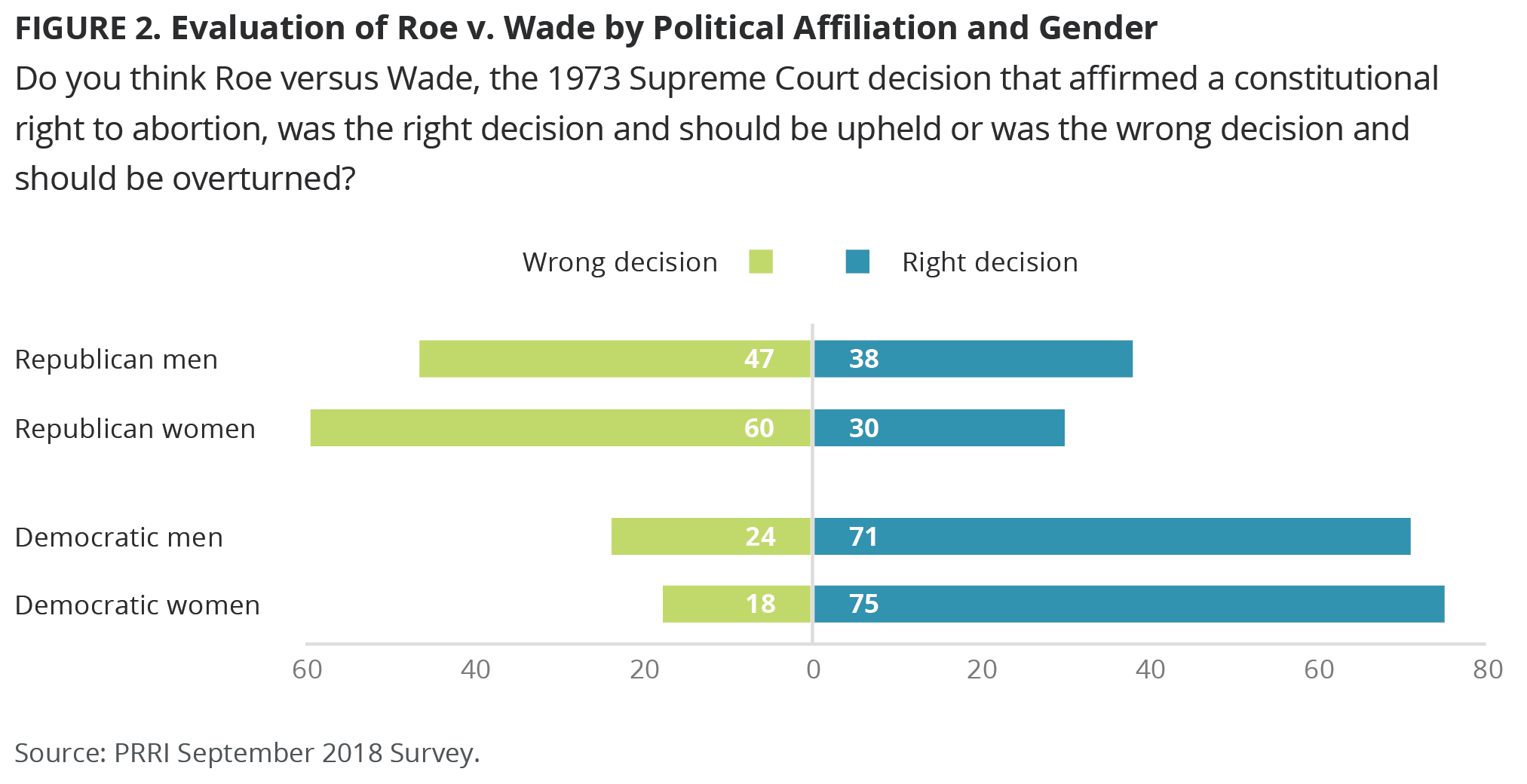
Those "male legislative bodies" were almost invariably elected by female-majority electorates. And Republican women had a huge hand in getting those candidates elected, because they opposed Roe even more strongly than Republican men. https://www.prri.org/wp-content/uploads/2018/09/F2-Evaluatio.... "Republican women" were also "the only group to say overwhelmingly that life begins at conception. About three-quarters said so, compared with less than half of Republican men and a third of Democratic women." https://www.npr.org/2019/06/07/730183531/poll-majority-want-...
And while you're correct that most women, nationally, oppose the most extreme restrictions, most women also support restrictions that Roe didn't allow: https://harvardharrispoll.com/wp-content/uploads/2022/07/HHP.... For example, 75% of women and 69% of men said abortions should not be available after 15 weeks (see p. 41).
What you're seeing with extreme abortion restrictions in deep red states is actually the product of women's political power. Anti-abortion women are among the most reliable voting blocs. While Roe was in effect, Republicans ran hard-line candidates to get those voters to turn out. More moderate Republicans, folks who say supported bans after 6 weeks or 12 weeks, could get on the same side of opposing Roe. When Roe was overturned, you had these hard-line candidates in office, who were significantly to the right on the abortion issue of even most voters in those states.
Coalition politics can often result in elected officials who are more extreme on certain issues than the electorate as a whole. For example, elected Democrats in California overwhelmingly supported Prop 16. But Prop 16 was defeated 60-40 in the referendum: https://newsroom.ucla.edu/stories/prop-16-failed-in-californ....
Polls quite consistently confirm a support for reproductive rights. You seem you know nothing about electoral politics in the US and how voter suppression, gerrymandering and other factors make such statements as yours entirely ridiculous. Same thing for gun control, actually.
Your characterization of who voted for Trump is way off [1]. 42% of female voters, 36% of voters 18-29. Your post also implies that older generations supported Roe, but it is widely accepted that the precedent established in Roe was legislation via the judicial branch. It was an undemocratic law forced upon them, rather than something they chose. Three quarters of states had laws criminalizing abortions at the time the amendment used to justify Roe was added to the constitution [2].
I won’t defend gerrymandering or voter suppression, but I will point out that it cuts both ways. In my own, left-leaning, state, no ID is needed to vote, so anyone can vote as anyone else so long as they know their address. There are stories all over the country about absentee ballots being mailed to dead people, etc. I perceive both parties as trying to rig rules around elections in order to favor their parties. The right does it by voter suppression and strict poll laws, and the left does it by making it easier for those who are not eligible to vote to do so.
I’m also curious what you mean by “this fascist assault”. What are you referring to as being a fascist assault and why?
There were fraudulent ballots cast for both candidates [1]. I'm not accusing anyone of widespread collusion; I'm just saying that it happens.
Either way, I think "is not a crime" is a low bar; "is morally correct and aligns with democratic principles" seems more correct in this case. Our system is founded on the principle of "one person, one vote". Anything that isn't in accordance with that (e.g. mailing a ballot to a dead person), even if it isn't illegal, seems like something our society should minimize or have fail-safes to prevent.
> The right does it by voter suppression and strict poll laws, and the left does it by making it easier for those who are not eligible to vote to do so.
Can you expound on how it is easier for people not eligible to vote to do so?
A trivial example is like I mentioned above. In Massachusetts, since there are no voter ID laws, I can walk into my local voting precinct and cast a vote on behalf of anyone whose address and name I know. I could do that as many times as I wanted to, for as many people as I know. I could vote a dozen times as a dozen people with ease. Someone who isn't a registered voter could do the same.
Instances like above probably don't have a direct impact on the outcome of elections (then again, neither does anyone who voted for the losing candidate, no matter how plentiful), but they undermine trust and faith in the democratic process, lower voter efficacy, reduce turnout, etc.
Voter suppression is actively trying to deny the rights of citizens, while 'enabling' (no I.D., easy to vote) is just a side effect of allowing people to exercise their constitutional right without having to get a government ID.
You have every right to feel the way you do, but to me it seems like a lopsided comparison. When one party is trying to remove a right and one party is allowing access to that right (even if a few people take advantage of it, but I am not convinced this occurs), this strikes me as evidently 'one wrong, and one right though a little sloppy'. Comparing the two as on equal footing doesn't seem honest.
> There are stories all over the country about absentee ballots being ...
"There are stories", up there with "People are saying".
When you've got some "stories" that will (a) stand up before a judge (b) are about actually illegality (c) would make a difference in the outcome of an election, I'd really like to hear them.
Although I broadly agree with this, I think you're missing the point that statistical characteristics of particular demographics can be very important.
For example, let's say that in fact roughly 30% of women are support a particular candidate, and that this number will not vary by much more than 5% in either direction. Given that women are more or less 50% of the population, that means that this candidate will need to make up a fairly significant vote deficit by over-appealing to some male demographic.
So yes, not all women or Latinos or African-Americans vote the same way, but if, statistically, enough of them do, then you can make some broad observations about candidate strategy that are likely consequential (and true).
So what if the case is weak? They should just let it slide then? Whatever country you're from, or whatever ideology you subscribe to, maybe you can appreciate the beauty of putting a strongman POS dictator wannabe on trial for even a parking violation.
Yeah I don't understand why so many people seem to be against this just because it's unlikely it will be raised to a felony or connected to other crimes.
Isn't it fine if this just hits Trump with a small fine or 3 days in jail or something? A fair punishment for a misdemeanor would be fine with me for this case. That's like the whole point of justice, that even the former president should have to follow the fine details.
In my state, our Democrat governor was accused of being a tyrant because of some minor paperwork she didn't do during emergency covid meetings. She still paid the fine because she committed the "crime" (procedural violation?) and that's how it should be. Politicians should not be immune to the little stuff. If they are speeding, they should get a ticket. If they shoplift, they should face a fine. If they forget to report a W2 to the IRS, they should get a pleasant letter telling them their mistake and they owe a few hundred dollars.
My concern isn't that this case is being prosecuted, but that all the stronger cases aren't. Sure, breaking campaign finance laws is bad and should be prosecuted, but he tried to overthrow the government! He had tons of classified documents in his basement and refused to return them. I truly do not understand why he hasn't been arrested for those two. They're more serious crimes, and there's plenty of evidence.


Here is an analogy I thought of. Say my firm's database gets ransomewared. If I pay the ransom directly, that may be a particular way of accounting. But say, I pay McCohen Computer Associates to fix the problem. Why do I not book it as a computer expense? I am not an accountant but am curious how this works.
Also, booking something in the wrong accounting category, doesn't seem like a very convincing charge. On the other hand, Tax and election violations are very serious.