These are from 5.4 million km away.
According to [1], in a few days (July 14) a Pluto system flyby is planned, at a distance of just 12.5 thousand km (and a speed of 13.78 km/s), and they can take images of Pluto's surface at 70m resolution. Pluto's circumference is 7232 km. So, do I understand this correctly that we can realistically expect to see much higher resolution images soon?
Or is the bandwidth really that limiting? It seems that even at 1kbps it would be possible and worth it to transfer some slightly higher resolution images. A typical color JPEG image at 640x480 is at most around 200kB, so that would take 27 minutes to transfer. For example here[2] is Mars at 640x480 in 38.4 kB. Is that unrealistic?
The raw image resolution isn't that bad [1], just that at that distance the planet is still pretty small. The LORRI instrument actually has an 8 inch mirror which is the best ever ever carried to the outer solar system.
As for receiving the high res images, the full data dump will take months after the flyby to be sent back. I read though as a fail safe in case new horizons were to damaged during the flyby that they will be transferring a high res image early into the flyby.
New Horizons is also unable to face Pluto and talk to earth at the same time, which limits what we can get back at this stage.
That's transmitted shortly after closest approach, but that won't be the highest resolution image taken. It's just the highest resolution where pluto still fits into the frame. The highest resolution images will just be of portions of Pluto. One will come in on the 15th, but I believe the rest won't be transmitted until September due to the slow uplink speed.
If I'm not mistaken they'll receive low-res versions of the pictures then download the full-sized ones later
From the Planetary Society website
"On September 14, New Horizons will begin downlinking a "browse" version of the entire Pluto data set, in which all images will be lossily compressed. It will take about 10 weeks to get that data set to the ground. There will be compression artifacts, but we'll see the entire data set. Then, around November 16, New Horizons will begin to downlink the entire science data set losslessly compressed. It will take a year to complete that process."
The P.I. Dr Alan Stern said at the Denver science museum a couple weeks ago they are a using as many of the backup instruments as they can to double the capacity. Many of the crucial instruments like the antenna have duplicates for the nine year journey.
If we are shortly going to have that kind of resolution of Pluto, I'm a little curious that we haven't mapped nearer objects down to almost Google maps level detail. I would think that with Cold-War spy satellite technology, even, orbiting the moon, we could have every inch mapped in short order.
Maybe we did already, and it wasn't that interesting? I remember the Google Earth desktop client having a Moon mode at one time, but that may have been a tie-in when Curiosity landed on Mars.
> The lunar observations made included imaging at various wavelengths in the visible as well as in ultraviolet and infrared, laser ranging altimetry, gravimetry, and charged particle measurements. These observations were for the purposes of obtaining multi-spectral imaging of the entire lunar surface
Does anyone know what kind of capacity the internal storage on NH has? I hope that it's not going to run into issues buffering across space and filling up it's SD card like the remote game cameras that I've put up, that get punked by overactive squirrels.
"For data storage, New Horizons carries two low-power solid-state recorders (one backup) that can hold up to 8 gigabytes (64 gigabits) each." (From [1] linked above.)
In 2005 that was about what they could fit on the craft with weight, power, space limits. Now it just a single memory stick.
The 2003 Mars rover Spirit was among the first to use flash. Even though the OS was 25 years old battle tested version of UNIX called VxWorks, the flash driver was new. It had a bug that incorrectly marked the free inode list on flash disk. So about six weeks into the mission the disk appeared to be full and caused a safe mode reboot every few hours. The engineers successfully uploaded a patch and one of rovers is still operational.
And we're still not flying memory sticks (but we are flying more memory than ever before). Fun fact: New Horizons has no file system on its recorder, but current missions at APL now do.
Then Japanese started to add those small reaction screens in the upper corners of the TV-competitions. Now it has taken over the world. Shows like MythBusters turned into collection to extended reaction shots to stuff that happens repeated over and over. You can see SpaceX having employees arranged to react and cheer and film crews filming the reactions half of the time.
We are spoon-fed with cues on how to react and reaction pics and interviews of people telling how amazing it and hyping it up has taken over.
Some people can find it draining, but I think there is good reasons why it's done. Competition for attention is fierce.
I think this is basically the same thing as a much older practice -- would you enjoy major holidays as much if people weren't so festive about them?
A sitcom with a laugh track may be less cinematically pure than the same sitcom with austere silence in the background, but watching a sitcom as a bonding activity works better with a laugh track.
So all things considered, it makes perfect sense to me for SpaceX to basically declare that certain occasions are SpaceX holidays and people should show a little more joy than usual.
Well they won't quite make it here on July 14th. The spacecraft will be spending most of July 14th making as many observations as it possibly can then in the following days/weeks/months we'll get a slow trickle of data back. The current plan actually calls for not getting a full download of all the data until November 2016! However we should have some reasonably good quality (lossy) compressed images back within the first week or so.
Oh use your imagination. Careful analysis of the 'Band of complex patterns' past the five craters on the left scares up a series of Japanese characters which would be transliterated fu ri (unfortunately) ji ra i (land mines). Later higher res imagery should clarify this.
If I squint, I kind of see two or three hexagonal shapes (or implied shapes), but right now it's little more than a Rorschach test. Let's wait until we get some better images.
The "did you know your browser is out of date" popup ruins the site on Android. If NASA's web team is reading this comment, please test your site on mobile.
Just for curiosity, do anyone here knows how much time it takes to transfer images from Pluto to the Earth? And also what protocols do the NASA use for doing this?
There are a couple of candidate Kuiper belt objects for a flyby in a year or two, they were found by Hubble after a search with ground telescopes came up with nothing. No decision has been taken about that flyby yet.
It is interesting to me that the one constant tradition in astronomy from antiquity to today is that we name features observed in the heavens of abstract shapes after things specific and unique to Earth.
From the man in the moon, to constellations shaped like swords or crabs, and now Pluto's whale - we seem to impose ethnocentrism on everything, no matter how remote.
> we seem to impose ethnocentrism on everything, no matter how remote
Because A5236 is so much better.
We either give random designations or non-random ones. Random ones are hard to remember. Non-random ones will obviously be named in a manner that makes it easier to remember, otherwise why go non-random? So if you're naming something with the goal of making it easy to remember, then yes, you're going to name it after something that it resembles, however slightly.
Please put the political correctness back on the shelf.
I realise that this is probably a troll, but right now (http://pluto.jhuapl.edu/) New Horizons is 14 million kilometres from Pluto. That's 12 light seconds. By comparison, the moon is 1.5 light seconds away.
That picture you were complaining about was taken on 2015-01-25, over six months ago. The vehicle's moving at 16 km/s, which means that it was an additional 290 million kilometres away then. That's nearly a thousand light seconds away. Sixteen light minutes. By comparison, that's the entire width of Earth's orbit.
We need the frickin' Hubble Space Telescope to take good pictures of planets at that sort of distance. It's a tribute to the New Horizon team's technical skill that they managed to resolve Pluto and Charon at all in that picture.
I'm afraid that on HN the combination of "Grar guberment", "I don't understand technology more complex than CRUD applications", and a bonus racial slur merely invoke Poe's Law for me.
You have an intuitive "expectation" of a certain image quality and data cadence. Your expectations, though, are based only on intuition from consumer electronics, wall outlets, and your living room. In other words, they are irrelevant.
You need to think about the fundamental physical limitations (mass, distance, power) and work backward from these constraints. That's how engineering works.
For example, the "bandwidth" of the iPhone you refer to would be zero. It's battery would be inoperable at 4 degrees Kelvin, and it has no directional antenna, and it would not know where to point it even if it did.
Imaging tech is not the issue, we have plenty of ability to capture HD image (not movie level... but definitely internet level). Bandwidth, however, is a severe limitation.
Typically the technology aboard any space craft is 5 years older or older when it's being sent because it needs to be hardened and tested against the harsh radiation of space. So we're talking imaging tech from at best 2001 on this thing.
So yes bandwidth is an issue but so is the imaging technology. They couldn't put an HD camera on this thing.
Actually, I'm sure they could have, but a larger camera would have required a larger telescope in front, not to mention the bandwidth issue. Elsewhere in this discussion it's mentioned that the flyby data will be stored in two mirrored 8 GB units and slowly streamed back home through November 2016 (we'll get some lossily compressed images earlier, although nothing until the fly-by is finished and the main radio antenna again points at earth).
So an 8.2 inch mirror, largest ever sent to the outer solar system, with a 1024x1024 bits CCD, which isn't bad at all, weighing in at 19.4 pounds and an average power of 5.8 watts (http://pluto.jhuapl.edu/Mission/Spacecraft/Payload.php)
I'd like to point out that space is an extremely large and harsh environment. The three main issues:
1) Distances are huge. Light needs ~5 hours to travel from Pluto to Earth. This means high-gain (=large), directional antennas, and low data-rates to make sure you actually receive the same data that the craft transmits to you (and vice versa).
2) Electronics need to be shielded from radiation and cosmic rays. On Earth, the atmosphere does a this for us (and we still get hit by cosmic rays, leading to things like randomly flipped bits). If you have a space-craft that cannot be directly controlled from Earth (because, 5 hours one-way communication time), you need it to be somewhat autonomous. Random bit-flips can spell disaster, so you need to either bring a ton of shielding, redundant (and well-tested, aka "outdated") systems, or both.
3) All these things add mass to your vehicle. Mass is the single largest cost driver in launch operations.
In summary, space is difficult and expensive to get to and operate in. This costs money. Money is finite, especially in a world where many people would like to see space exploration funding cut because it provides no immediate tangible return.
"We choose to go to the moon! We choose to go to the moon in this decade and do the other things, not because they are easy, but because they are hard..."
According to the Office of Management and Budget, NASA's 2014 budget was $17.65 billion. Total spending on the military of the United States in 2013 was $610.1 billion. That means that NASA received the equivalent of 2.8% of our "on the books" (e.g. no emergency allocations) military spending or 0.492% of the total Federal budget.
Meanwhile, NASA delivers pictures of planets (no apologies, Pluto is a planet) so far away we can only barely see them from Earth and has provided the technology to park multiple upon multiple communication devices in orbit and around our solar system.
I can only imagine what they'd do with over $600 billion each year.
The common thing I see in your comments is that you have seriously inflated, unreasonable expectations. No one promised HD streams from Mars. You can't have that, for the reasons outlined by other commenters. The problem isn't with NASA, it's with your expectations. We're not in XXIV century yet.
Outside of military technology? Clearly, you have not been following the the JSF (Joint Strike Fighter) program. Stealth, multi-purpose, VTOL fighter-jet, able to replace most combat aircraft for all three branches of service. Oops...
If you're actually interested in pictures produced by the current Mars rover, I can recommend the interactive New York Times website dedicated to its progress[1]
I really don't understand what your point is. Are you saying we should not be exploring the solar system? It took almost a decade for this spacecraft to get where it is now. I think you are purposefully ignoring the technical difficulties, which we've manage to address mind you, of transmitting data over that kind of (almost inconceivable) distance.
For the sake of giving you the benefit of the doubt that you're not, in fact, trolling, please elaborate on what you think NASA should be doing instead of exploring the last unexplored major celestial body in our solar system.
You'd rather have zero data than data that comes in slowly? Come on this is hacker news. Quit being a troll.
If you have a better way to conduct communications between Earth and a space craft billions of miles away using technology from over a decade old then you should apply to NASA and prove it.
Remember they have the DSN which this can't tap into (afaik) which has higher bandwidth. But this shit isn't exactly easy. Even if it is easy this is a hardware design from 15 years ago...
Main problem with space stuff is radiation if you send up consumer electronics like iphones. The small transistors in consumer electronics would break from a single hit.
You could ofcorse just send more of them.
But as we can see NASA has gone the other way. Hard to say which is the better way.
I am a little frustrated at the "slow" pace of NASA puts the raw LORRI images on their public website. The newest is two days old. At this pace of approach every few hours closer has a new and more fantastic image. At least NASA puts up raw data fairly quickly. ESA takes months for its Mars and Rosetta images.
Note that the craft can't take pictures and send data at the same time, so it only sends back a few navigation images and only periodically, fewer now as they're doing more science as it gets closer. It also takes up to 4 or 5 hours to transmit the images (I think they're down to ~1 kbps now). The last few seem to have been posted within less than a day of the team receiving them.
It's a few pixels across because it's not a telescope, it's a probe.
It's not about "this day and age", it's about designing something that can do a lot of science when it's close, instead of something that can do a fraction as much from farther away.
Even the best camera in the world would give you results that are pretty much the same.
If you want to ignore distance, then you should probably look at the entire frame of the camera. I'm sure it can take some wonderful snapshots of the stars that aren't grainy at all.
But if you zoom via cropping, your image quality goes away. That's not a failure of design in any way.
It's imaging hardware likely from 2001 or older. Remember this space craft has been in flight for almost 10 years, in development for several years before that and the imaging hardware needs to be well tested and hardened for space flight.
Even if it was today's hardware, we'd still be getting grainy images from this distance. It might be slightly better, but not the amazing hi-res images people on this thread seem to be expecting. Pluto is really small and far away. It's just a tiny spot even to Hubble.
Well get the hi-res images once new horizons actually does its flyby and once the data is downloaded.
There's one person in this thread who is disappointed. Everyone else seems to recognise this as the amazing thing it is.
Perhaps we just need some kind of infographic? If the camera is a single pixel, how many pixels away is Pluto? What's the equivalent using (as one person suggested) a iPhone camera?
LORRI, the camera taking these photographs has a resolution of 4.9 µradians per pixel. From what I can put together, the iPhone 6 has a horizontal resolution of about 340 µradians per pixel. So a 70-pixel-across image of pluto from LORRI (about what we have here[1] taken about two days ago) would appear to be a single pixel on an iPhone 6.
It's possible that single pixel wouldn't show up at all since it's pretty dim all the way out there, but Apple has been working hard on their low-light image capture :)
And that's of course not accounting for radiation protection, a very carefully designed CCD and mounting so you can actually do science with the results, calibration after riding up on a rocket, sensitivity across 350nm to 850nm, etc.


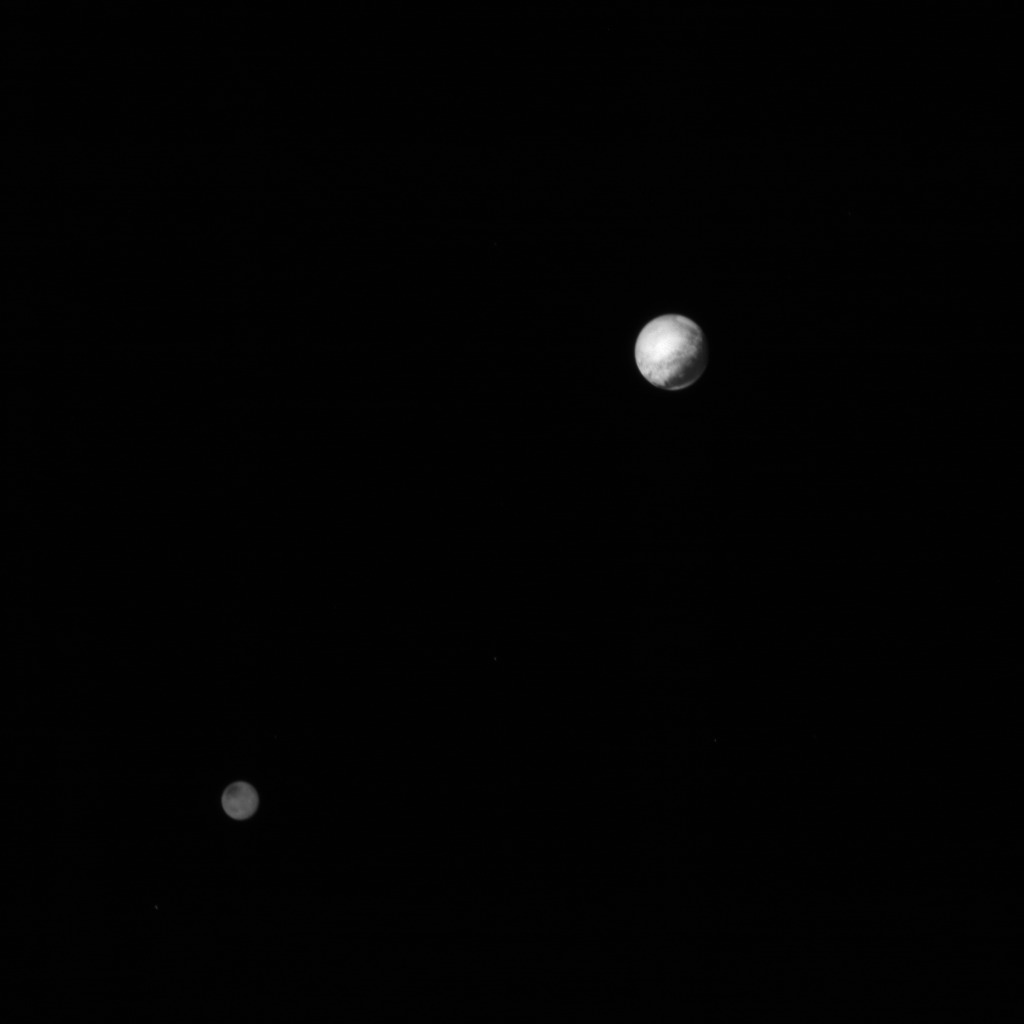

Or is the bandwidth really that limiting? It seems that even at 1kbps it would be possible and worth it to transfer some slightly higher resolution images. A typical color JPEG image at 640x480 is at most around 200kB, so that would take 27 minutes to transfer. For example here[2] is Mars at 640x480 in 38.4 kB. Is that unrealistic?
[1] http://pluto.jhuapl.edu/News-Center/Resources/Press-Kits/NHP...
[2] http://i.imgur.com/0vdGSV1.jpg